

Atrial flutter (AFL) is an arrhythmia characterized by organized (macroreentrant) atrial electrical activity and can be classified as typical or atypical. Typical AFL uses the cavotricuspid isthmus as part of its circuit, and the impulse may rotate through this structure counterclockwise (90% of cases) or clockwise (10%). In the counterclockwise circuit, we see the classic sawtooth “F” waves, negative in the inferior leads and positive in V1. Atypical AFL depends on any other atrial anatomical barrier.
Electrocardiographic Criteria
Typical atrial flutter
- Presence of “sawtooth” F waves
- The RR interval is regular if AV conduction is fixed (1:1, 2:1, 3:1, etc.) or irregular if there is variable AV block
- Typical counterclockwise AFL shows “sawtooth” F waves, usually negative in the inferior leads (II, III, and aVF) and in V6, but positive in V1
- Typical clockwise (or reverse) AFL shows F waves that are predominantly positive in the inferior leads and in V6, but negative or W-shaped in V1
Atypical atrial flutter
- The F wave in the inferior leads (II, III, and aVF) matches V1. For example, if the F wave is positive in the inferior leads, it will also be positive in V1
ECG in Atrial Flutter
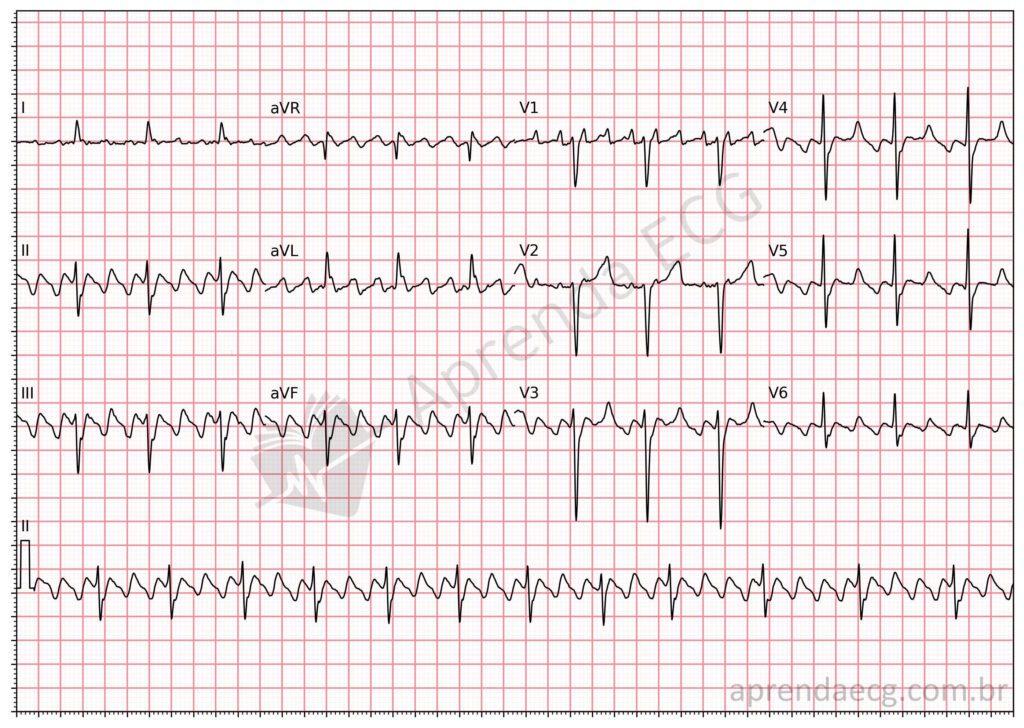
Atrial flutter. Note the “sawtooth” F waves in the inferior leads (II, III, and aVF) with 2:1 AV conduction.
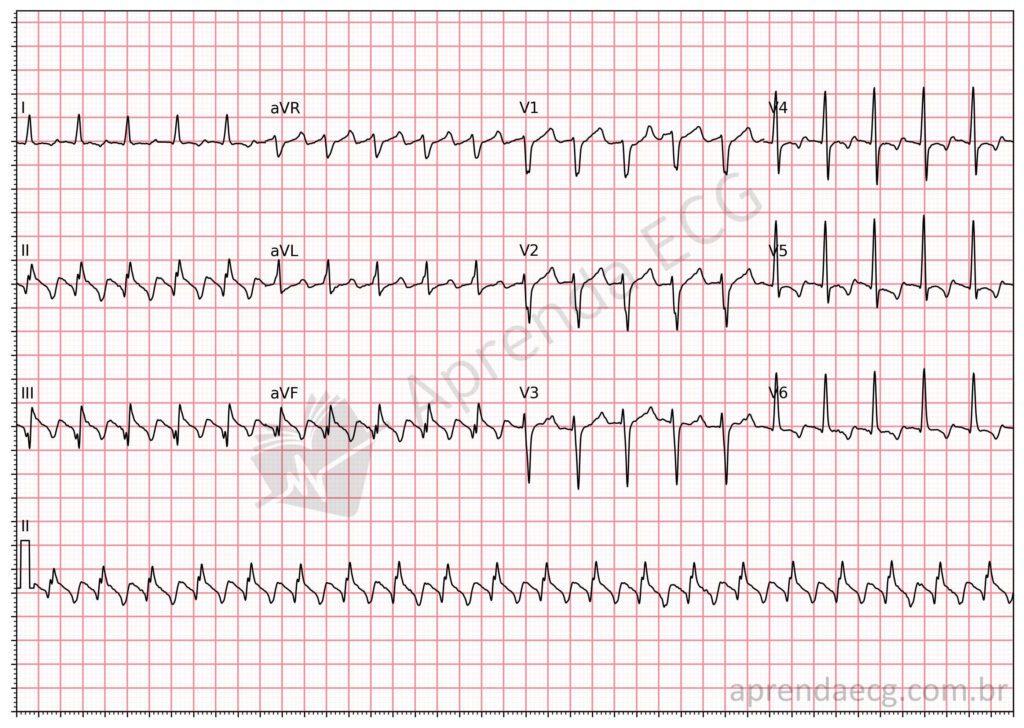
Atrial flutter. In this example, the F waves are very evident in the inferior leads (II, III, and aVF) and in V1. AV conduction is variable: it is 3:1 at the beginning of the tracing, but there are moments when it becomes 4:1 toward the end.
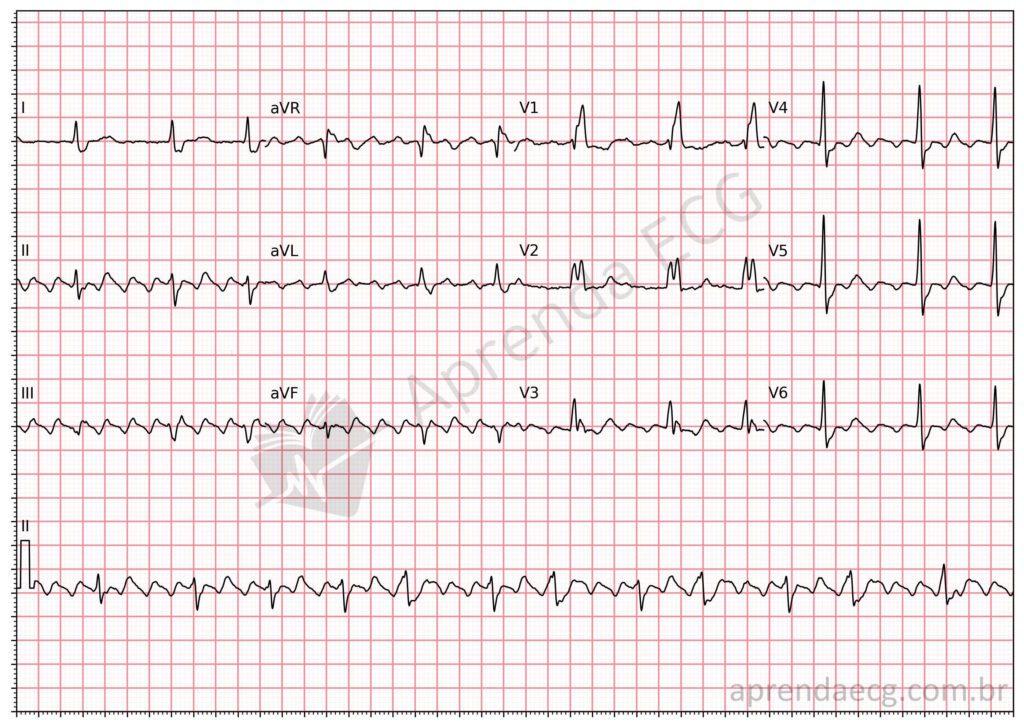
Atrial flutter. Atrial flutter can be an irregular rhythm when AV conduction is variable, as in this example. Also note that the QRS complexes are wide because of RBBB.
Related Topics
References
- Scheffer MK, De Marchi MFN, de Alencar Neto JN, Felicioni SP. Eletrocardiograma de A a Z. São Paulo: Manole, 2024.
- Alencar JN. Tratado de ECG. 2022.
- Issa Z, Miller J, Zipes D. Clinical Arrhythmology and Electrophysiology: A Companion to Braunwald’s Heart Disease. 3rd ed. Philadelphia: Elsevier; 2019. 752 p.
- Brugada J, Katritsis DG, Arbelo E, Arribas F, et al. 2019 ESC Guidelines for themanagement of patients with supraventricular tachycardia. Eur Heart J. 2020;41(5):655–720.


