

Atrioventricular reentrant tachycardia (AVRT) is a macroreentrant arrhythmia that involves the conduction system and accessory pathways as part of its circuit. It can take two forms: orthodromic or antidromic. In orthodromic AVRT, the accessory pathway is responsible for the retrograde limb of the circuit, while the conduction system is responsible for anterograde conduction. In antidromic AVRT, the electrical impulse is conducted to the ventricle exclusively over the accessory pathway in the anterograde direction and returns to the atrium through the normal conduction system.
Electrocardiographic Criteria
Orthodromic AVRT
- Narrow QRS tachycardia with a regular RR interval
- Short RP interval, > 70 ms
- HR between 150 and 250 bpm
- ST-segment depression may occur because of fusion of the ST segment with the retrograde P wave
- Electrical alternans (QRS alternans)
Antidromic AVRT
- Wide QRS tachycardia due to maximal pre-excitation, with a regular RR interval
- Indistinguishable from ventricular tachycardia (VT)
- The retrograde P wave is usually not visible because of the widened QRS and ST-T segment
- HR up to 250 bpm
ECG in Atrioventricular Reentrant Tachycardia
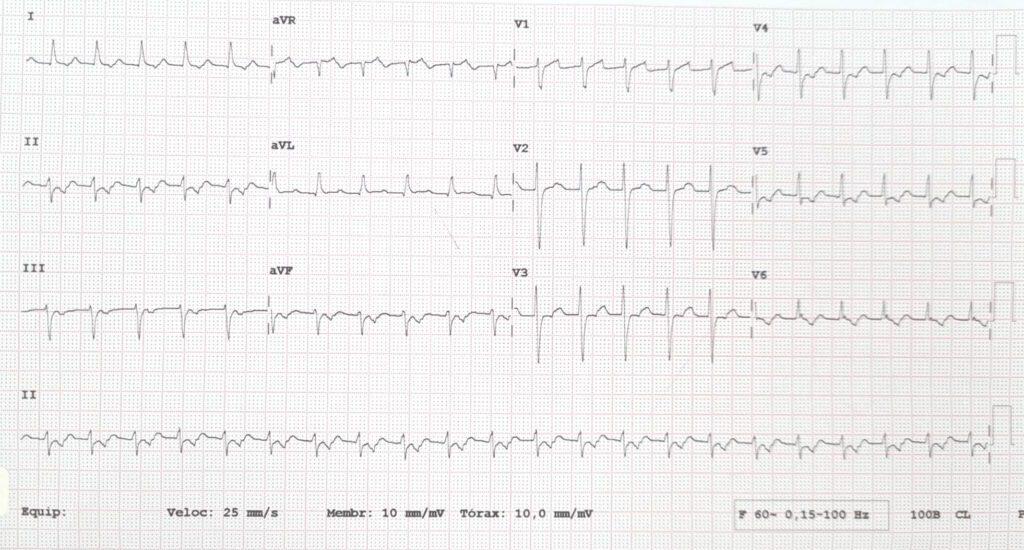
Atrioventricular reentrant tachycardia. Narrow QRS tachycardia with a retrograde P wave (negative in the inferior leads) within the ST segment. The RP interval is short and longer than 70 ms.
Related Topics
References
- Scheffer MK, De Marchi MFN, de Alencar Neto JN, Felicioni SP. Eletrocardiograma de A a Z. São Paulo: Manole, 2024.
- Brugada J, Katritsis DG, Arbelo E, Arribas F, et al. 2019 ESC Guidelines for themanagement of patients with supraventricular tachycardia. Eur Heart J. 2020;41(5):655–720.


