

For AV nodal reentrant tachycardia (AVNRT) to occur, two conduction pathways through the AV node are required (dual AV nodal physiology): an alpha pathway with slow conduction and a short refractory period, and a beta pathway with fast conduction and a long refractory period. In its typical form, anterograde activation occurs over the slow pathway and retrograde activation over the fast pathway, followed by anterograde ventricular activation through the His-Purkinje system. Atrial activation may occur before, during, or at the end of the QRS complex.
Electrocardiographic Criteria
- The retrograde P wave may be hidden within the QRS complex or appear after the QRS, forming a pseudo-s wave in II, III, and aVF and a pseudo-r’ in V1
- Short RP interval, < 70 ms
- Regular RR interval
- HR usually between 150 and 250 bpm
ECG in AV Nodal Reentrant Tachycardia
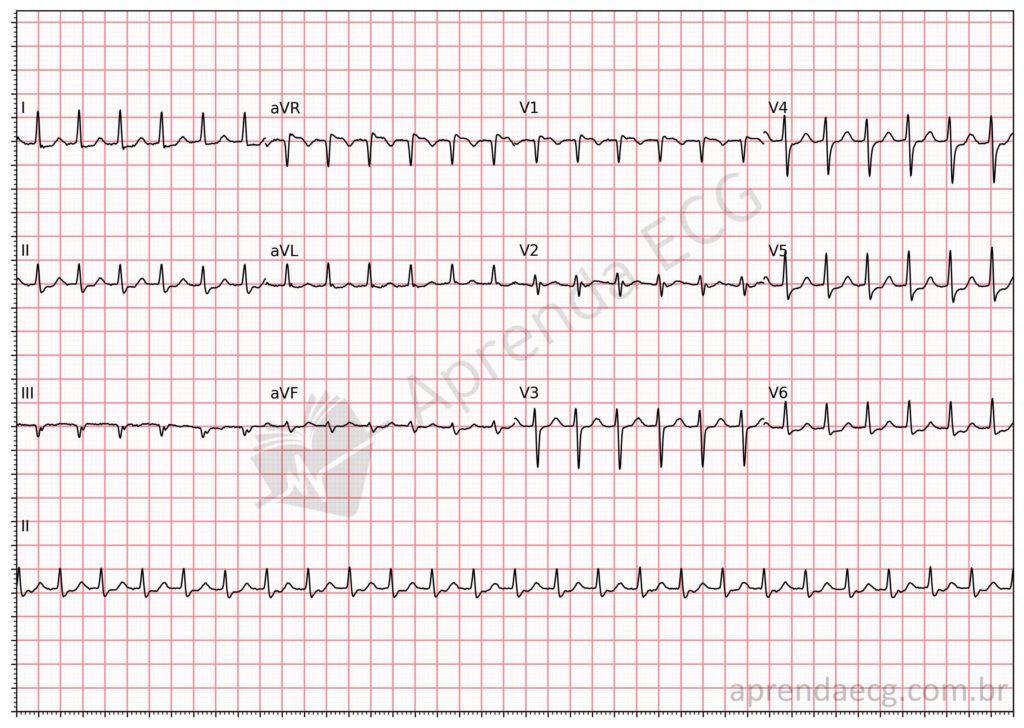
AV nodal reentrant tachycardia. Episode of narrow QRS tachycardia with pseudo-s waves in the inferior leads (II, III, and aVF) and pseudo-r’ in V1, produced by retrograde atrial activation, which disappear after conversion to sinus rhythm (next ECG).
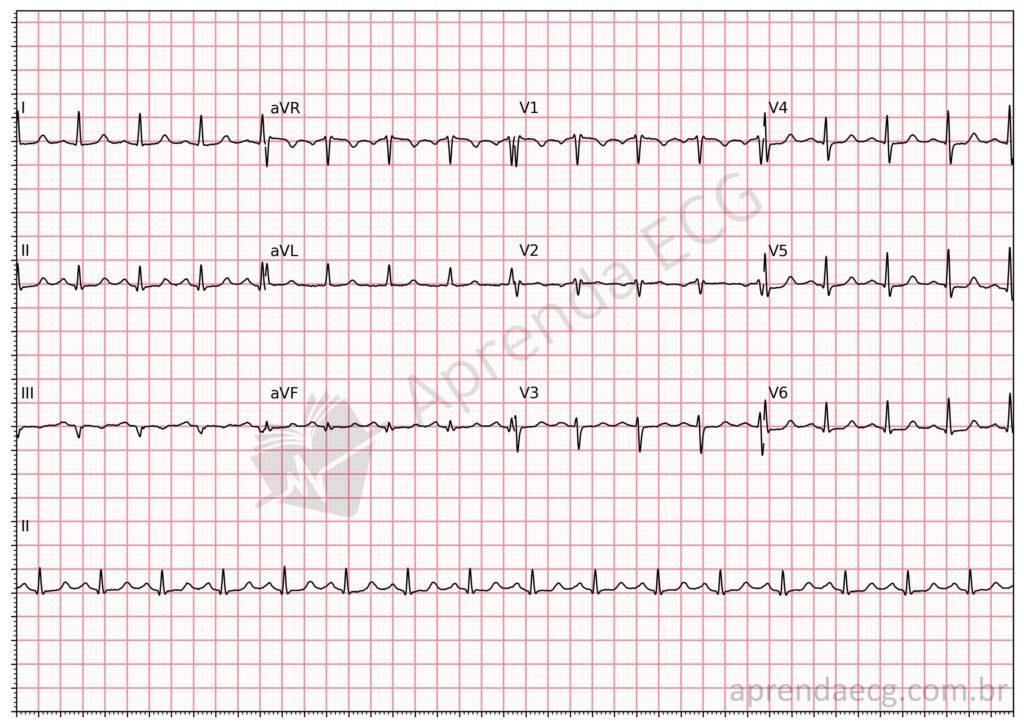
Sinus rhythm. Compare the baseline ECG in sinus rhythm with the ECG during AVNRT.
Related Topics
References
- Scheffer MK, De Marchi MFN, de Alencar Neto JN, Felicioni SP. Eletrocardiograma de A a Z. São Paulo: Manole, 2024.
- Brugada J, Katritsis DG, Arbelo E, Arribas F, et al. 2019 ESC Guidelines for themanagement of patients with supraventricular tachycardia. Eur Heart J. 2020;41(5):655–720.


