Have you heard of the Morris index? This electrocardiographic criterion is an essential tool for identifying left atrial enlargement, a condition frequently associated with various heart diseases. But how exactly does it work, and how relevant is it in clinical practice? In this post, we cover what the Morris index is and how to apply it when analyzing the ECG.
What Is the Morris Index?
The Morris index is an electrocardiographic criterion used to diagnose left atrial enlargement. Developed in 1964 by J.P. Morris and colleagues, it is based on analysis of P-wave morphology on the ECG, specifically in lead V1. Left atrial enlargement is an important sign, frequently related to conditions such as hypertension and valvular heart disease.
How to Assess the Morris Index on the ECG
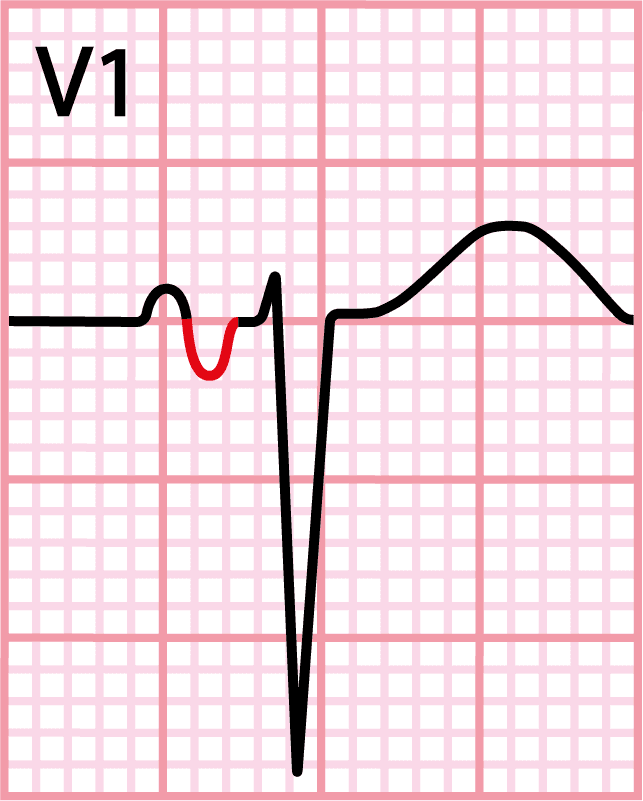
To calculate the Morris index, look at the negative component of the P wave in lead V1. According to the criterion, a negative P-wave deflection lasting more than 40 milliseconds (1 small box) with an amplitude greater than 1 mm (that is, a total area greater than 1 mm²) suggests left atrial enlargement. This feature reflects greater electrical activity of the left portion of the atrium, indicating dilation or hypertrophy.
Clinical Significance of Left Atrial Enlargement
Left atrial enlargement is not an isolated entity but an important marker of underlying heart disease. Conditions such as hypertension, mitral valve disease (particularly mitral stenosis), and heart failure often result in left atrial enlargement, which can be detected on the electrocardiogram using the Morris index.
Limitations of the Index
Although the Morris index is an important marker of left atrial enlargement, it is not 100% sensitive or specific. The criterion may not be sufficient in some situations, especially in patients with other ECG abnormalities or in cases of low-amplitude P waves. Therefore, the physician must consider the overall clinical picture and use other diagnostic methods, such as echocardiography, to confirm the presence of left atrial enlargement.
Key Points
- The Morris index is a criterion used to diagnose left atrial enlargement by analyzing the P wave in lead V1.
- A negative P-wave component in V1 lasting more than 40 milliseconds with an amplitude greater than 1 mm suggests left atrial enlargement.
- This index helps in the diagnosis of conditions such as hypertension and valvular disease, but it should not be used in isolation.
References
- Morris JP, et al. “The criteria for left atrial enlargement in the electrocardiogram.” American Heart Journal, 1964.
- Hancock EW, et al. “AHA/ACCF/HRS Recommendations for the Standardization and Interpretation of the Electrocardiogram.” Circulation, 2009.
- Scheffer MK, De Marchi MFN, de Alencar Neto JN, Felicioni SP. Eletrocardiograma de A a Z. São Paulo: Manole, 2024.
- Scheffer MK, Ohe LN, de Alencar Neto JN. Manual Prático de eletrocardiograma. 2022.
- Alencar JN. Tratado de ECG. 2022.