

Clinical case
A 58-year-old man, previously healthy, seeks care for mild episodic dizziness. He denies syncope, chest pain, or dyspnea. He takes no medications.
The electrocardiogram obtained on admission is shown below.
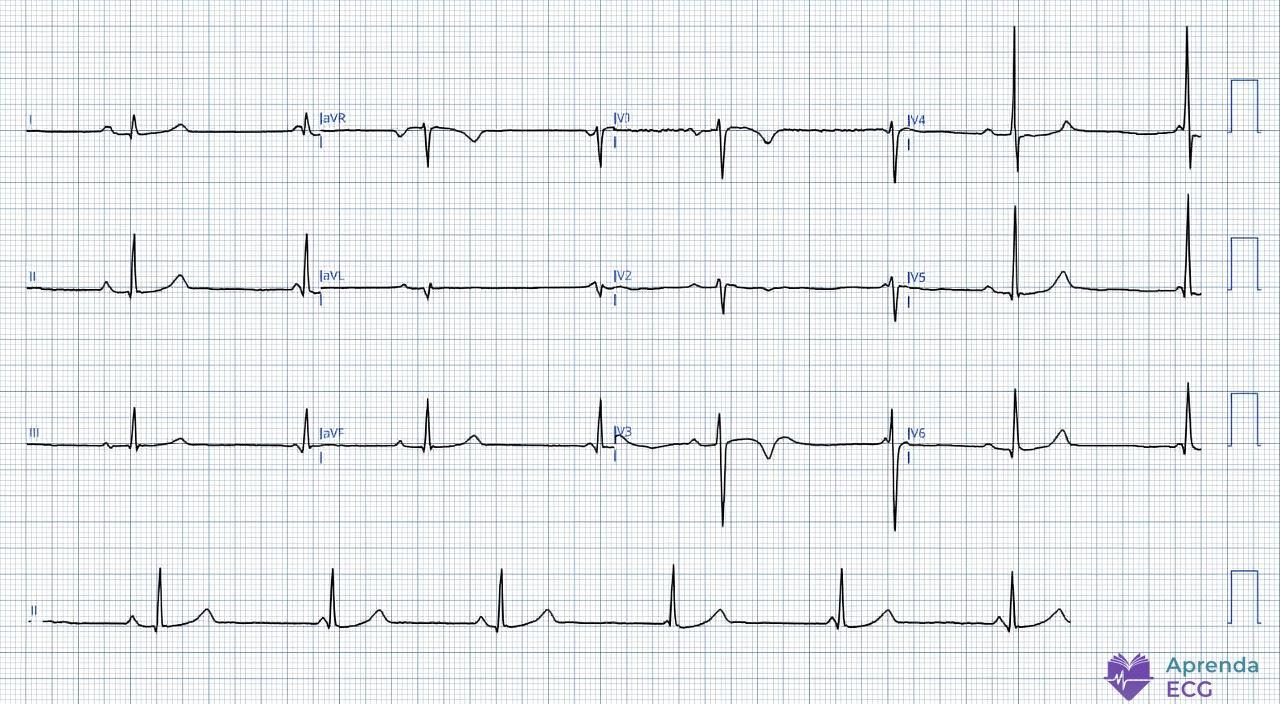
What is the diagnosis?
Are we looking at complete atrioventricular block?
Answer
No. The ECG shows isorhythmic dissociation.
Isorhythmic dissociation: why is it not complete AV block?
Isorhythmic dissociation is a form of atrioventricular dissociation in which the atrial rate is very similar to the ventricular rate, but not exactly the same.
The main electrocardiographic criteria are:
- Presence of AV dissociation
- Atrial rate very close to the ventricular rate
- Variable PR interval
- P wave “moving in and out” of the QRS
In this tracing, there is no fixed synchrony between P waves and QRS complexes. However, the rates are practically identical. At times the P wave appears to precede the QRS with a short PR interval; at other times it moves progressively away, until it apparently coincides with the complex or separates from it.
This behavior creates the impression that the P wave is “dancing” around the QRS.
In complete AV block, on the other hand, the atrial rate is usually clearly higher than the ventricular rate, reflecting complete failure of conduction. Here, what happens is competition between two pacemakers with similar automaticity.
Electrophysiological mechanism
In isorhythmic dissociation, there are two active pacemakers:
- The sinus node depolarizing the atrium
- The AV junction (or a distal focus) depolarizing the ventricle
When the sinus rate falls slightly below the junctional automatic rate, the junctional rhythm takes over control of the ventricles.
Because the rates are so close, a dynamic relationship between activations develops. The AV node is refractory when the sinus impulse arrives, preventing anterograde conduction. Likewise, the junctional impulse cannot capture the atrium retrogradely, because the atrium is also refractory.
The result is AV dissociation with similar rates, a feature that distinguishes this pattern from complete AV block.
Key points
- Not every AV dissociation is complete AV block.
- Similar atrial and ventricular rates suggest isorhythmic dissociation.
- A variable PR interval is a key clue.
- The QRS is usually narrow, because the rhythm is typically junctional.
The correct diagnosis avoids misinterpretation as advanced block and unnecessary interventions.
References
- Scheffer MK, De Marchi MFN, de Alencar Neto JN, Felicioni SP. Eletrocardiograma de A a Z. São Paulo: Manole, 2024.