

Clinical case
A 72-year-old man with hypertension presents to the emergency department with recurrent episodes of presyncope over the past 24 hours. He denies chest pain.
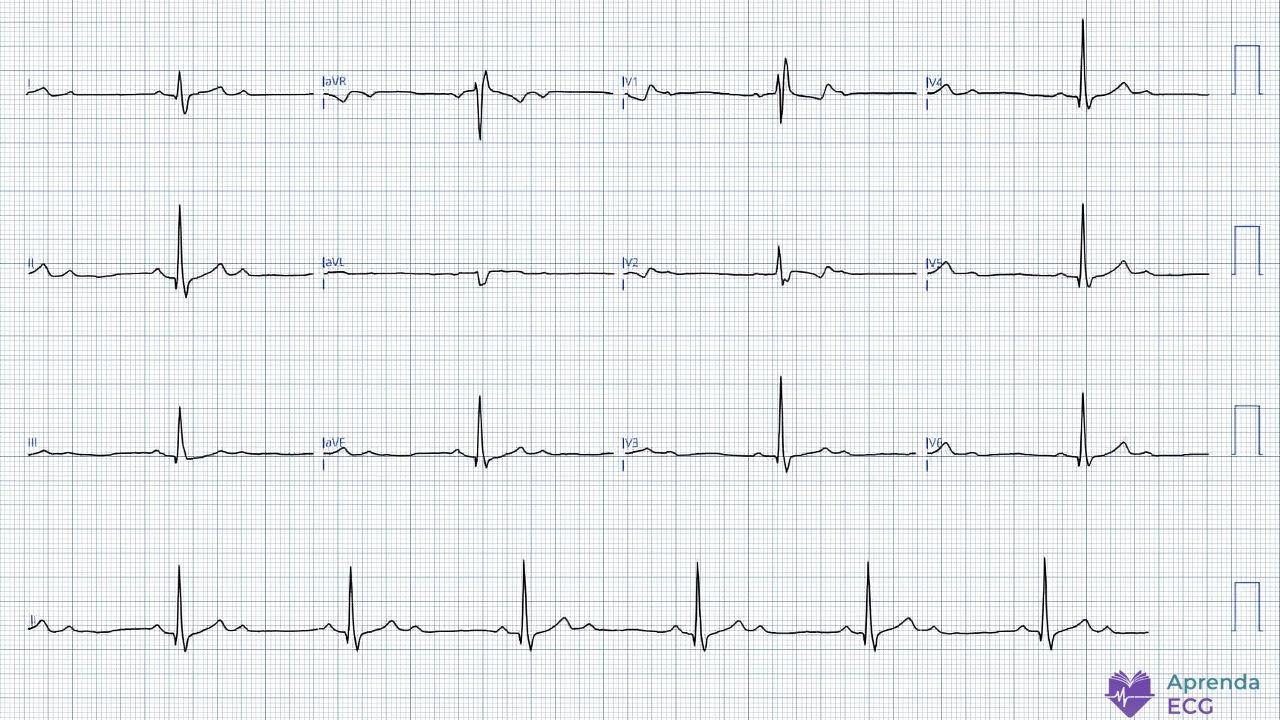
The ECG below was obtained.
What is the likely anatomical location of the block?
Answer
The ECG shows 2:1 atrioventricular (AV) block, characterized by one conducted P wave followed by one blocked P wave, with a constant PR interval in the conducted beats.
In addition, there is a widened QRS (≥ 120 ms) with typical right bundle branch block (RBBB) morphology: rsR’ pattern in V1 and slurred S waves in the lateral leads.
The combination of 2:1 AV block with a widened QRS suggests infranodal block, located in the His-Purkinje system.
Clinical discussion
The main challenge with 2:1 AV block is not just recognizing the pattern, but determining where the block is.
A 2:1 AV block can be nodal or infranodal.
A few points help the reasoning:
- A narrow QRS suggests nodal block.
- A widened QRS (≥ 120 ms) suggests infranodal block.
- A fixed PR interval in the conducted beats supports a functional Mobitz II-type pattern.
In this case, the RBBB indicates involvement of the His-Purkinje system. If the block already manifests as 2:1 and the QRS is widened, the probability that the conduction failure lies below the AV node is high.
Infranodal blocks carry a higher risk of progression to complete atrioventricular block, with an unstable ventricular escape and a higher risk of syncope or sudden death.
In practical terms: in a symptomatic patient with 2:1 AV block and evidence of intraventricular conduction system disease, a permanent pacemaker should be considered.
A detailed analysis of the anatomical localization of atrioventricular blocks can be reviewed in:
On call, the right question is not just “what type of block is this?” but rather “is this block safe?”
In this scenario, the answer tends to be no.
References
- Scheffer MK, De Marchi MFN, de Alencar Neto JN, Felicioni SP. Eletrocardiograma de A a Z . São Paulo: Manole, 2024.
- Issa Z, Miller J, Zipes D. Clinical Arrhythmology and Electrophysiology: A Companion to Braunwald’s Heart Disease . 3rd ed. Philadelphia: Elsevier; 2019.
- Kusumoto FM, Schoenfeld MH, Barrett C, Edgerton JR, et al. 2018 ACC/AHA/HRS Guideline on the Evaluation and Management of Patients With Bradycardia and Cardiac Conduction Delay . J Am Coll Cardiol. 2019;74(7):e51–156.