

Clinical Case
A 68-year-old man with hypertension presents to the emergency department with palpitations of sudden onset 2 hours earlier. He reports mild dyspnea and no chest pain. The monitor shows a regular wide QRS tachycardia.
What is the cause of this wide QRS tachycardia?
The ECG
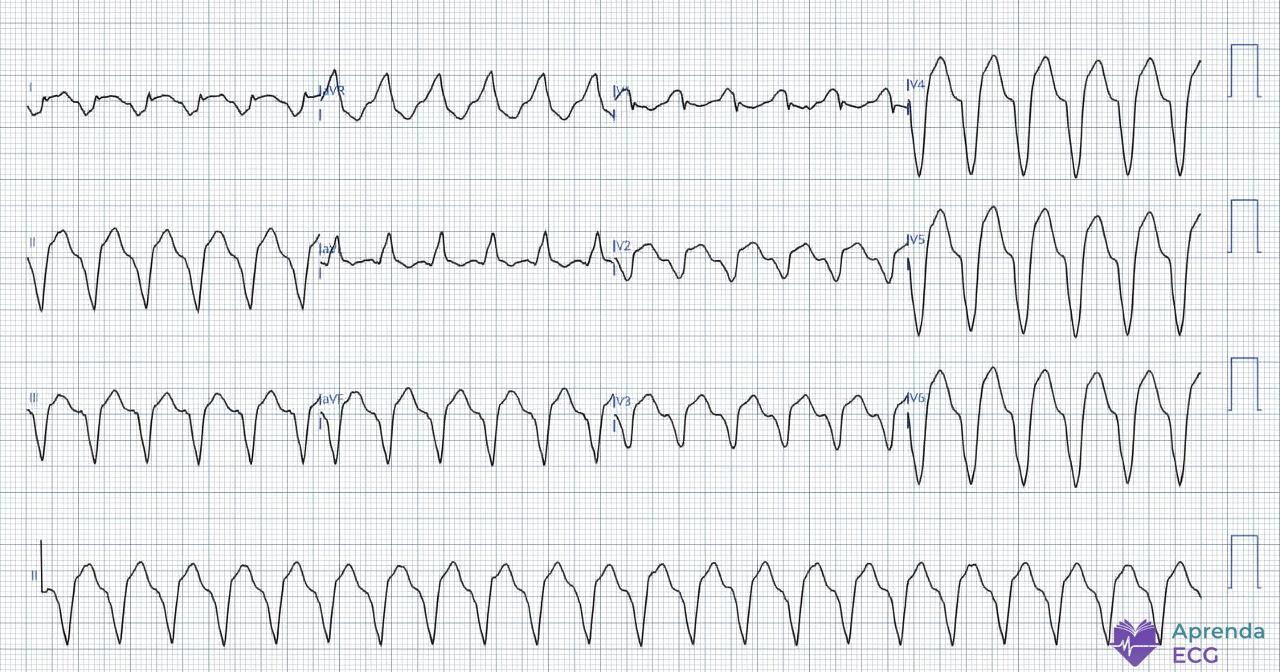
What Is the Diagnosis?
We are facing a regular tachycardia with a wide QRS. In this situation, is this ventricular tachycardia (VT) or supraventricular tachycardia (SVT) with aberrancy?
Applying the Brugada Algorithm to Wide QRS Tachycardia
The Brugada algorithm should be applied sequentially. If any criterion is positive, the diagnosis is VT.
Step 1: Absence of an RS complex in the precordial leads
There is an RS complex in V1. Therefore, we move on to the next step.
Step 2: RS interval longer than 100 ms in any precordial lead
An Rs pattern is seen in V1. At first glance, this might suggest bundle branch block and SVT with aberrancy.
However, when we measure the interval from the onset of the R wave to the nadir of the S wave, we find a value greater than 100 ms.
This criterion alone is enough to define ventricular tachycardia.
A prolonged ventricular activation time indicates an origin outside the His-Purkinje system. In other words: slow myocardial activation.
The algorithm could stop here.
Step 3: Morphological criteria
In addition, the morphological criteria for VT are also present, reinforcing the diagnosis.
Therefore, according to the Brugada algorithm, the diagnosis is suggestive of ventricular tachycardia.
Applying the Vereckei Algorithm
The Vereckei algorithm relies mainly on lead aVR and may be simpler at the bedside.
First criterion
The first criterion assesses the presence of an initial R wave in aVR.
On this ECG, this criterion is present.
Thus, by the Vereckei algorithm, we also reach the diagnosis of ventricular tachycardia at the very first step.
There is no need to proceed to the remaining criteria.
Practical Conclusion
This wide QRS tachycardia is ventricular tachycardia.
Key points:
- A regular wide QRS tachycardia in a patient over 35 years of age should be presumed to be VT until proven otherwise.
- An RS interval > 100 ms in a precordial lead is a diagnostic criterion in the Brugada algorithm.
- An initial R wave in aVR confirms VT by the Vereckei algorithm.
When in doubt, treat it as VT.