Clinical Case
A 64-year-old woman presented to the emergency department with typical ischemic chest pain.
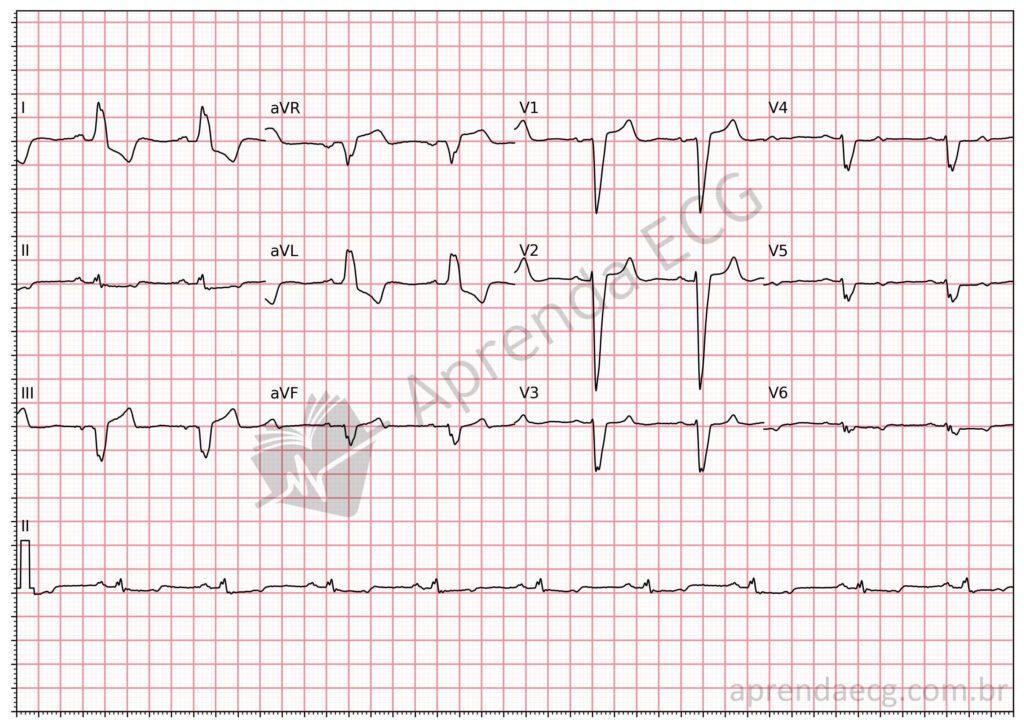
The initial electrocardiogram shows left bundle branch block (LBBB).
In this setting, can the ECG still help diagnose occlusion myocardial infarction (OMI)?
Answer and Discussion
1) LBBB does not rule out the diagnosis of OMI
Historically, LBBB made it difficult to recognize acute myocardial infarction.
We now know that specific ST-segment changes can indicate occlusion myocardial infarction even in the presence of LBBB.
The main criteria used include:
- Original Sgarbossa criteria
- Smith-modified criterion
- Barcelona algorithm (Di Marco)
2) The key finding on this ECG
On this tracing, note:
- Lead aVR with QRS amplitude < 6 mm
- ST elevation of approximately 1 mm
This pattern meets one of the criteria of the Barcelona algorithm.
3) When does the Barcelona algorithm suggest OMI?
The algorithm is considered positive for occlusion myocardial infarction when there is:
- ST elevation > 1 mm concordant with the QRS
- ST depression > 1 mm concordant with the QRS
- ST deviation > 1 mm discordant with the QRS, with R or S amplitude < 6 mm
In this case, the third criterion is present.
Therefore, even with LBBB, the ECG suggests an ongoing OMI.
4) Angiographic confirmation
Coronary angiography showed a subocclusive lesion in a large posterior ventricular branch.
The patient underwent angioplasty with stent implantation.
Practical Points
- LBBB does not exclude OMI.
- Modern criteria increase diagnostic sensitivity.
- QRS amplitude is an essential part of the analysis.
- The ECG remains a decisive tool in the emergency department.
References
- Di Marco A, Rodríguez M, Cinca J, et al. New Electrocardiographic Algorithm for the Diagnosis of Acute Myocardial Infarction in Patients With Left Bundle Branch Block . J Am Coll Cardiol. 2020;75(5):505-515.