

A rare pattern in the setting of acute coronary occlusion (OMI), it is considered a STEMI equivalent and is very frequently associated with thrombotic occlusion or subocclusion of the left anterior descending artery.
Electrocardiographic Criteria
- Upsloping ST-segment depression in leads V1-V2 to V6
- Peaked, tall, symmetric T waves (hyperacute T waves)
ECG in the “de Winter” Pattern
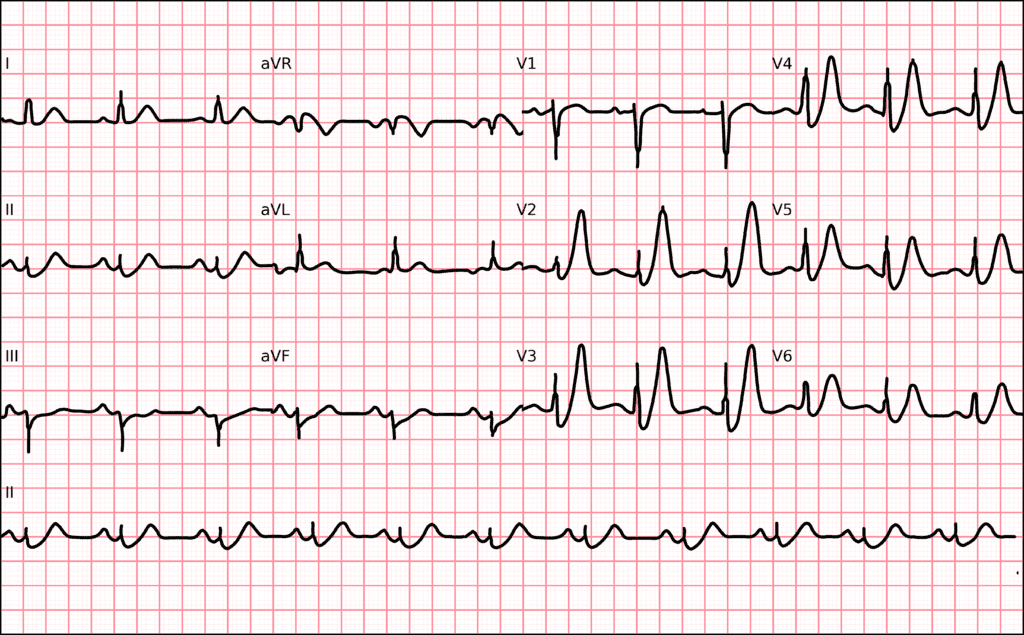
“de Winter” pattern. Characteristic J-point depression followed by an upsloping ST segment and hyperacute T waves from V2 to V6.
Further Reading
Related Topics
References
- Felicioni SP, de Alencar Neto JN, Centemero MP, Lourenço UR, De Marchi MFN, Scheffer MK, et al. The de Winter electrocardiographic pattern: A systematic review of case reports. J Electrocardiol. 2024 Nov;153821.
- de Winter RJ, Verouden NJW, Wellens HJJ, Wilde AAM. A New ECG Sign of Proximal LAD Occlusion. N Engl J Med. 2008;359(19):2071–3.
- Verouden NJ, Koch KT, Peters RJ, Henriques JP, et al. Persistent precordial “hyperacute” T-waves signify proximal left anterior descending artery occlusion. Heart. 2009;95(20):1701–6.


