

Left anterior fascicular block (LAFB) is an electrocardiographic abnormality caused by delayed or blocked conduction through the anterosuperior division of the left bundle branch of the His bundle. On the ECG, it is characterized by left axis deviation beyond -45°, with normal or slightly widened QRS complexes (<120 ms). In addition, there is a qR pattern in leads I and aVL and an rS pattern in II, III, and aVF.
Electrocardiographic Criteria
- Left axis deviation in the frontal plane between -45° and -90°
- qR pattern in aVL
- rS pattern in II, III, and aVF with S in III > S in II
- Ventricular activation time > 45 ms in aVL
- QRS duration < 120 ms
ECG in Left Anterior Fascicular Block
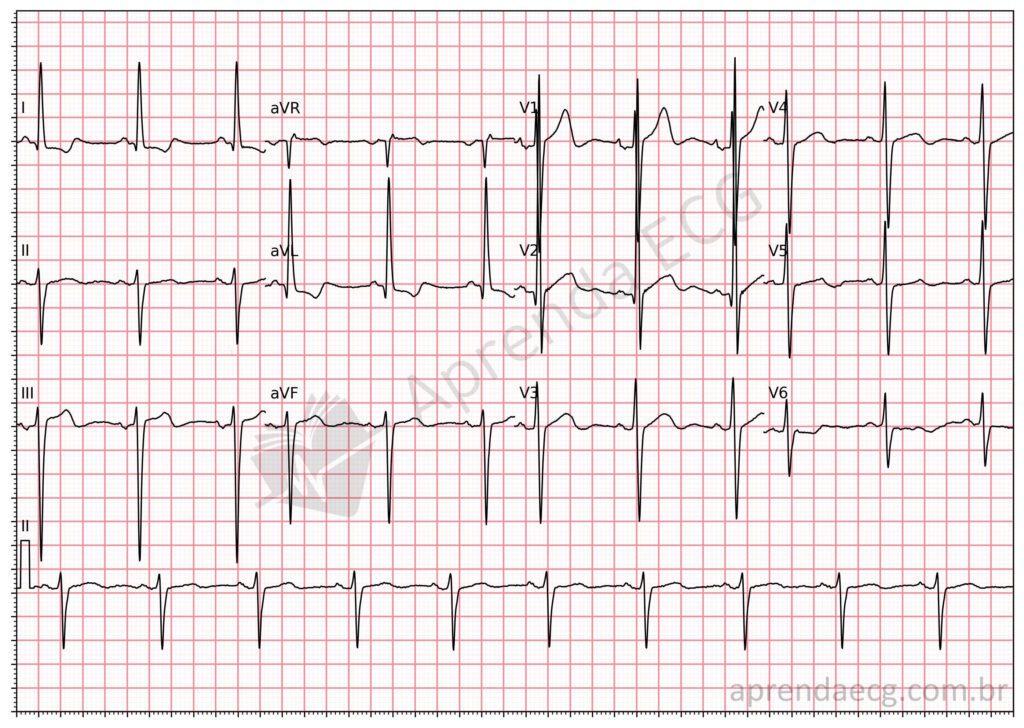
Left anterior fascicular block. Block of the anterosuperior fascicle produces characteristic electrocardiographic changes, such as axis deviation beyond -45°, rS morphology in II, III, and aVF (with the S wave in III larger than the S in II), qR morphology in I and aVL, and ventricular activation time greater than 45 ms in aVL. Note also that this example shows signs of left ventricular hypertrophy.
Related Topics
References
- Surawicz B, Childers R, Deal BJ, Gettes LS. AHA/ACCF/HRS Recommendations for the Standardization and Interpretation of the Electrocardiogram. Part III: Intraventricular Conduction Disturbances. J Am Coll Cardiol. 2009;53(11):996–981.
- Elizari M V. Fascicular Blocks: Update 2019. Curr Cardiol Rev. 2021;17(1):31–40.


