

Masquerading bundle branch block is a rare form of intraventricular conduction disturbance associated with higher mortality and a worse prognosis. In this setting, there is extensive damage to the conduction system, associated with a large area of fibrosis and significant left ventricular hypertrophy. It frequently progresses to complete or advanced atrioventricular block, requiring pacemaker implantation.
Electrocardiographic Criteria
- A prominent R wave in V1 (RBBB pattern), left axis deviation in the frontal plane, and absent or < 1 mm S waves in I and aVL, mimicking LBBB in the frontal plane leads
Mechanism of the Block
This block occurs when RBBB is accompanied by advanced block of the anterosuperior fascicle and structural changes in the left ventricle, such as significant hypertrophy and/or extensive fibrosis. The combination of these factors directs the terminal forces to the left, canceling the typical RBBB forces and eliminating the S waves in leads I and aVL.
Clinical Considerations and Prognosis
- The prognosis is generally guarded because this condition is associated with severe structural heart disease and an increased risk of adverse events.
- This electrocardiographic pattern is often linked to advanced, extensive damage to the conduction system and indicates significant fibrosis and left ventricular hypertrophy. These factors contribute to increased mortality and indicate a less favorable prognosis.
- Patients with masquerading bundle branch block have a higher incidence of progression to advanced atrioventricular (AV) block or complete heart block, often requiring a permanent pacemaker.
ECG in Masquerading Bundle Branch Block
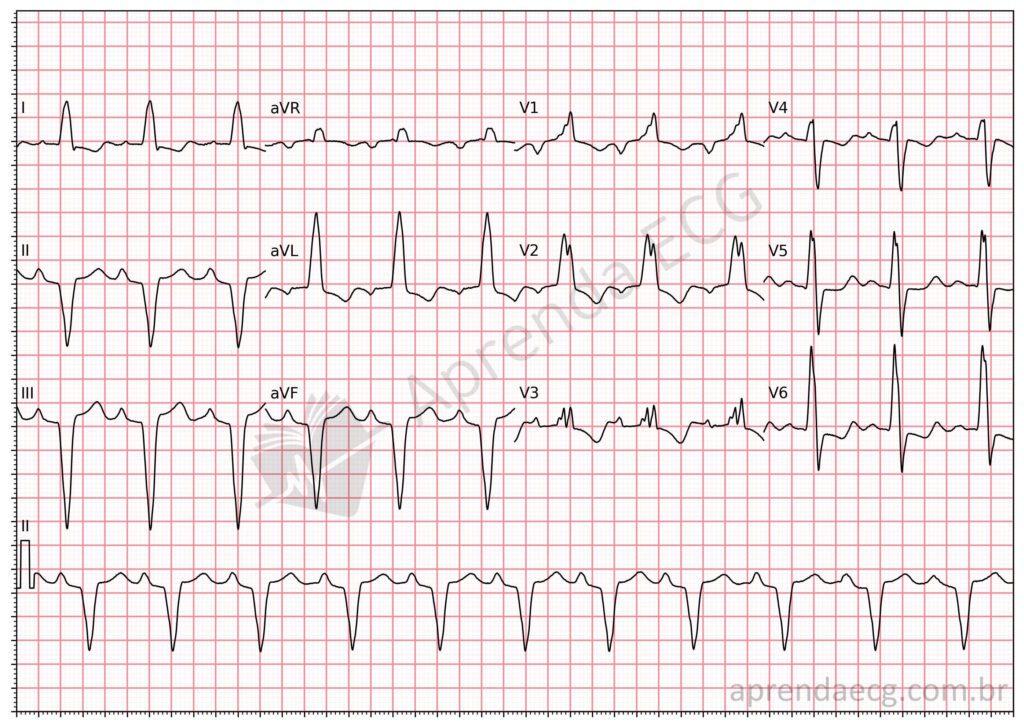
Masquerading bundle branch block. Masquerading bundle branch block is a severe form of intraventricular conduction disturbance in which we see an RBBB pattern in the horizontal plane (positive QRS complex in V1) and an LBBB pattern with left axis deviation in the frontal plane (note the absence of slurred s waves in I and aVL, as would be expected in RBBB).
Further Reading
Related Topics
References
- Scheffer MK, De Marchi MFN, de Alencar Neto JN, Felicioni SP. Eletrocardiograma de A a Z. São Paulo: Manole, 2024.
- Scheffer MK, De Marchi MFN, Costa ACM. Right Bundle-Branch Block Pattern in Precordial Leads and Left Bundle-Branch Block Pattern With Left Axis Deviation in Frontal Plane Leads—What Does This Mean? JAMA Intern Med. 2022;182(12):1315.
- Elizari M V, Baranchuk A, Chiale PA. Masquerading bundle branch block: a variety of right bundle branch block with left anterior fascicular block. Expert Rev Cardiovasc Ther. 2013;11(1):69–75.
- Richman JL, Wolff L. Left bundle branch block masquerading as right bundle branch block. Am Heart J. 1954;47(3):383–93.
- Unger PN, Lesser ME, Kugel VH, Lev M. The Concept of “Masquerading” Bundle-Branch Block. Circulation. 1958;17(3):397–409.


