

What Is an Accessory Pathway?
Accessory pathways are abnormal electrical connections between the atria and the ventricles that bypass the heart’s normal conduction system. In individuals with Wolff-Parkinson-White (WPW) syndrome, these pathways can allow early conduction of the electrical impulse, giving rise to the phenomenon called ventricular preexcitation.
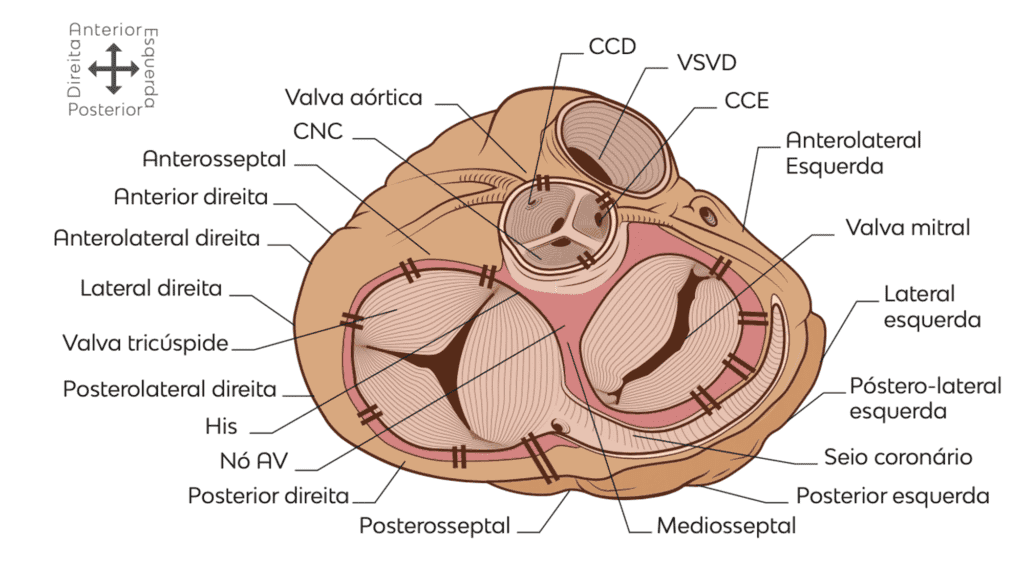
What Is Ventricular Preexcitation?
Ventricular preexcitation occurs when an electrical impulse reaches the ventricle through an accessory pathway before passing through the atrioventricular (AV) node. On the electrocardiogram (ECG), this translates into a short PR interval, a delta wave (a sign of early conduction), and a widened QRS complex.
Preexcitation may be asymptomatic, but it can also trigger arrhythmias such as atrioventricular reentrant tachycardia, preexcited atrial fibrillation, or, in severe cases, ventricular fibrillation.
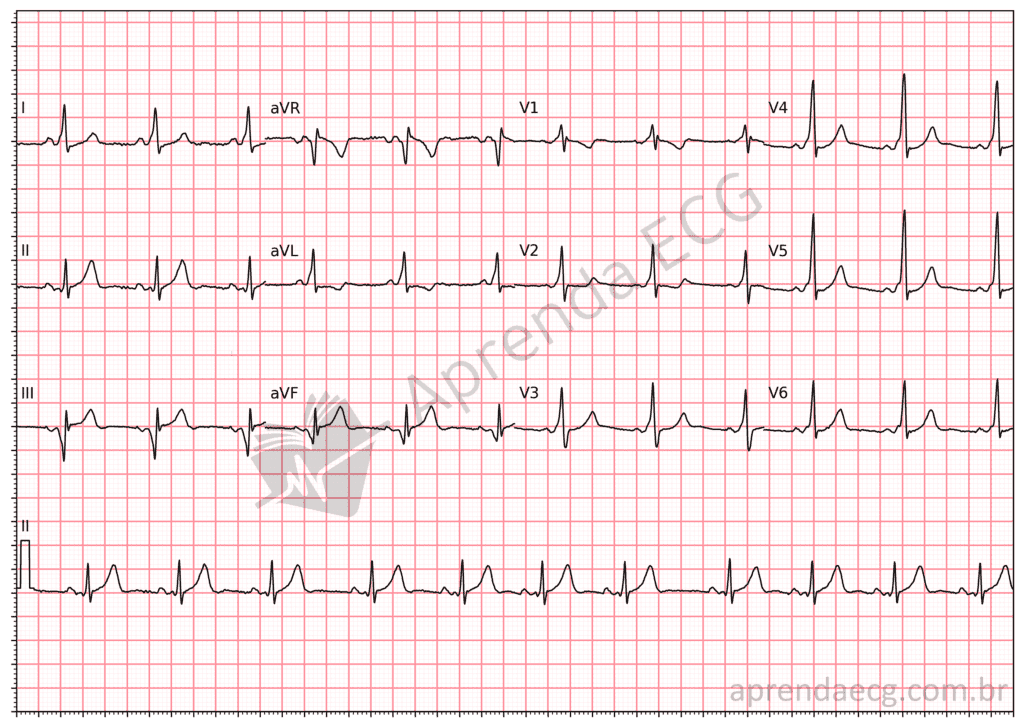
Why Is Localizing the Accessory Pathway Important?
Accurate identification of the accessory pathway location is essential for planning catheter ablation, which aims to eliminate this abnormal pathway and prevent arrhythmias.
The position of the accessory pathway determines the vascular access required (transaortic or transseptal), the risks of ablation (such as proximity to the conduction system), and even the type of energy used. For this reason, several electrocardiographic algorithms have been developed to estimate the pathway location based on features of the delta wave and the QRS.
What Are the Main Accessory Pathway Localization Algorithms?
The best-known algorithms use delta-wave polarity, the QRS transition in the precordial leads, and analysis of QRS morphology in specific leads. The main algorithms used in clinical practice include:
- Arruda et al. (1998)
- Fitzpatrick et al. (1994)
- D’Avila et al. (1995)
- Iturralde et al. (1996)
- Chiang et al. (1995)
- Taguchi et al. (2013)
- EASY-WPW (2023)
Although useful, these algorithms show divergent results in many cases, mainly due to anatomical variability among patients, the presence of multiple pathways, or atypical ECGs.
A recent study showed that the accuracy of these algorithms varies widely, with success rates that rarely exceed 60% in clinical practice when the exact location is required.
Limitations of Existing Algorithms
Despite their widespread use, traditional algorithms have some important limitations:
- Low accuracy in atypical ECGs, especially when the delta wave has an unexpected polarity.
- Difficulty predicting pathways located in the posterior septum or in epicardial positions.
- Poorer performance in pediatric patients, who have different body types.
- In some cases, the algorithms suggest locations that do not match the findings at the procedure, which may compromise the initial ablation strategy.
The EPM Algorithm: Our Team’s Proposal
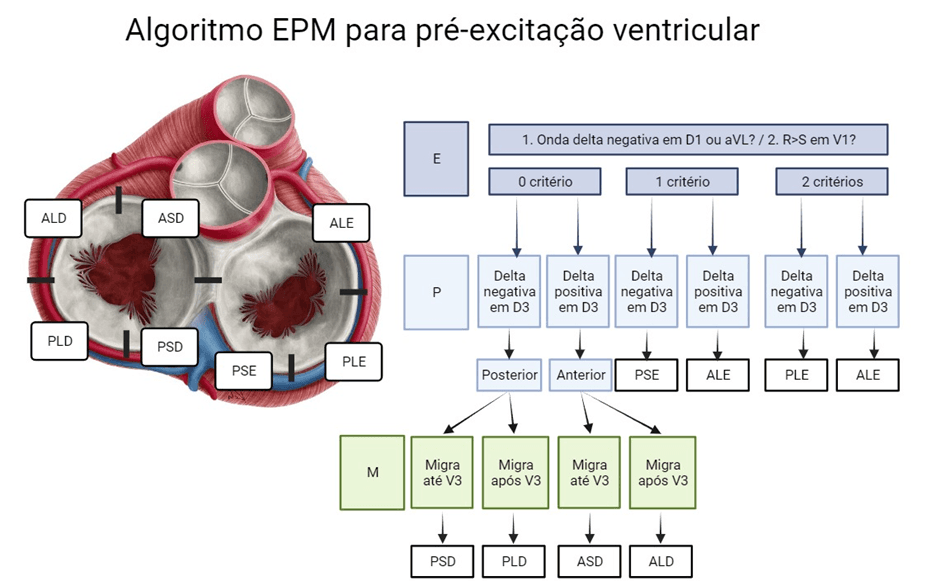
Given these limitations, our team developed the EPM algorithm, a systematic and teaching-friendly approach to localizing accessory pathways from the ECG.
How Does the EPM Algorithm Work?
The algorithm is divided into three steps:
- E – Esquerda (left) or right?
- If the delta wave is negative in I or aVL, or if R > S in V1, the pathway is probably left-sided.
- P – Posterior or anterior?
- Delta-wave polarity in III determines whether the pathway is posterior (negative) or anterior (positive).
- M – Precordial migration (applicable to right-sided pathways)
- A QRS transition before V3 suggests a septal pathway; at V4 or later, it suggests a lateral pathway.
Performance of the EPM Algorithm
- Overall diagnostic accuracy: 51.45% (similar to classic algorithms such as Arruda and EASY)
- Accuracy for adjacent location: 70.67%
- Sensitivity for distinguishing left vs. right pathways: 95.73%
- Excellent interobserver agreement (Kappa > 0.9)
These results, based on 138 patients from a tertiary center, show that the EPM is reliable, reproducible, and useful in clinical practice.
Conclusion
Localizing accessory pathways from the ECG is an important tool in electrophysiology practice, but it must be used with caution. Algorithms help estimate the pathway position and plan the ablation, but errors are common.
The EPM algorithm offers a simple, logical, and effective approach, especially useful for cardiologists, residents, and electrophysiology trainees. Its standardized reasoning and good accuracy reinforce its role as a complementary tool in planning the treatment of ventricular preexcitation.
References
- Sousa Ferro AC, et al. Algorithms for locating accessory pathways: How far should we trust? J Electrocardiol. 2025;91:153936.
- de Alencar Neto JN, et al. EPM algorithm: A stepwise approach to accessory pathway localization in ventricular pre-excitation. J Electrocardiol. 2024;84:1–8.
- Arruda MS, McClelland JH, Wang X, Beckman KJ, Widman LE, Gonzalez MD, et al. Development and validation of an ECG algorithm for identifying accessory pathway ablation site in Wolff-Parkinson-White syndrome. J Cardiovasc Electrophysiol 1998;9(1):2–12.
- Chiang CE, Chen SA, Teo WS, Tsai DS, Wu TJ, Cheng CC, et al. An accurate stepwise electrocardiographic algorithm for localization of accessory pathways in patients with Wolff-Parkinson-White syndrome from a comprehensive analysis of delta waves and R/S ratio during sinus rhythm. Am J Cardiol 1995;1;76(1): 40–6.
- Fitzpatrick AP, Gonzales RP, Lesh MD, Modin GW, Lee RJ, Scheinman MM. New algorithm for the localization of accessory atrioventricular connections using a baseline electrocardiogram. J Am Coll Cardiol 1994;23(1):107–16.
- Taguchi Noriko, Yoshida Naoki, Inden Yasuya, Yamamoto Toshihiko, Miyata Shinjiro, Fujita Masaya, et al. A simple algorithm for localizing accessory pathways in patients with Wolff-Parkinson-White syndrome using only the R/S ratio. J Arrhythmia 2013;30(6):439–43
- D’Avila A, Brugada J, Skeberis V, Andries E, Sosa E, Brugada P. A fast and reliable algorithm to localize accessory pathways based on the polarity of the QRS complex on the surface ECG during sinus rhythm. Pacing Clin Electrophysiol 1995 Sep;18(9 Pt 1):1615–27.
- Iturralde P, Araya-Gomez V, Colin L, Kershenovich S, de Micheli A, Gonzalez- Hermosillo JA. A new ECG algorithm for the localization of accessory pathways using only the polarity of the QRS complex. J Electrocardiol 1996;29(4): 289–99.
- El Hamriti M, Braun M, Molatta S, Imnadze G, Khalaph M, Lucas P, et al. EASY- WPW: a novel ECG-algorithm for easy and reliable localization of manifest accessory pathways in children and adults. Europace 2023;25(2):600–9.