

Differentiating ventricular tachycardia (VT) from supraventricular tachycardia with aberrancy (SVT-A) in wide QRS tachycardia is one of the most critical scenarios in clinical electrocardiography. Although most wide QRS tachycardias are VT, the distinction is not always intuitive, and wrong decisions can lead to inappropriate therapy.
The Basel algorithm was developed to make this decision simpler and faster. Unlike classic algorithms based on complex morphological criteria, it uses three objective clinical and electrocardiographic criteria with a clear binary rule: two or more positive criteria define VT.
What Is the Basel Algorithm?
The Basel algorithm is an integrated strategy that combines:
- 1 clinical criterion
- 2 simple electrocardiographic criteria
VT is diagnosed when ≥ 2 of the 3 criteria are present.
If only 0 or 1 criterion is positive, the diagnosis favors SVT with aberrancy.
The logic is probabilistic and cumulative: it does not depend on sophisticated morphological analysis or multiple sequential steps.
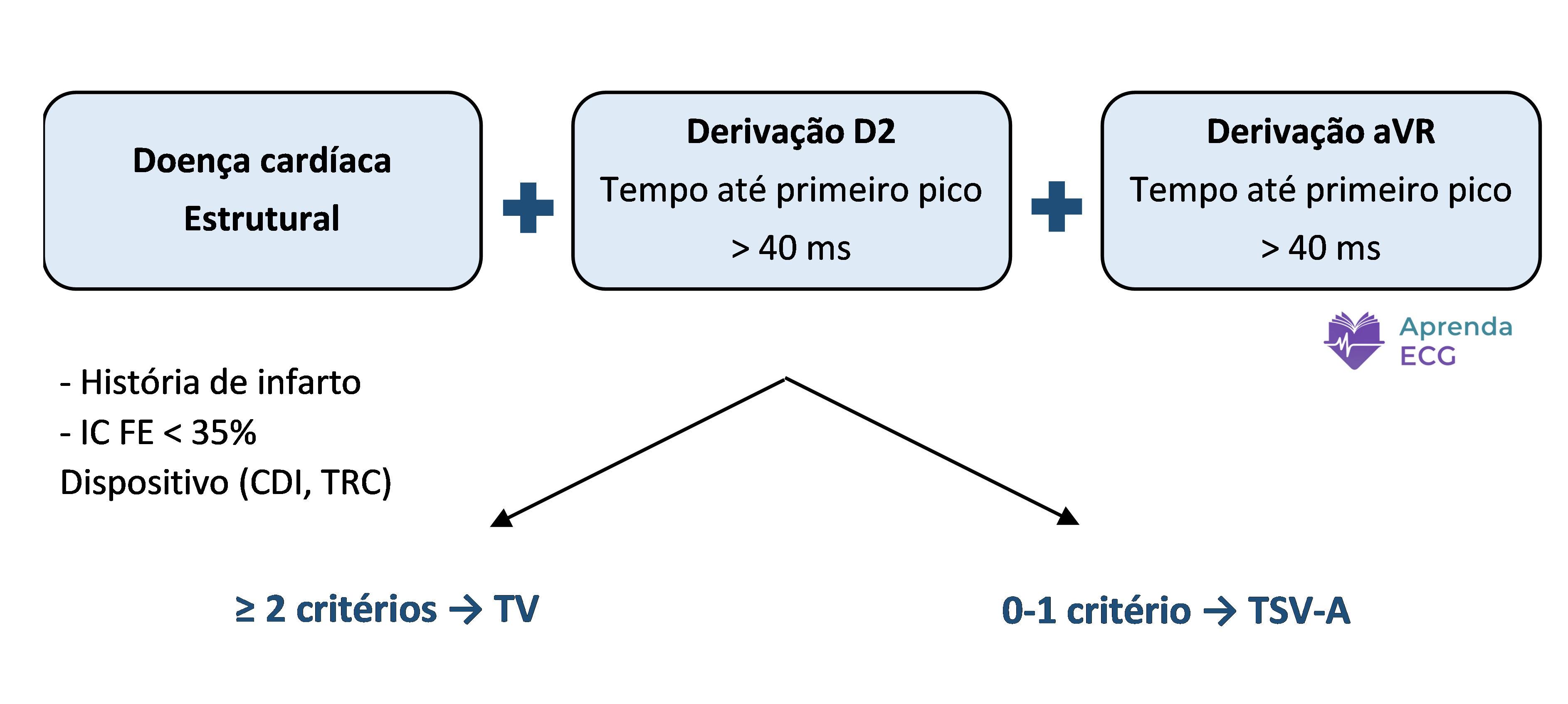
Step 1: Assess Clinical Risk (Structural Heart Disease)
The first component of the Basel algorithm is clinical.
The criterion is positive when at least one of the following is present:
- History of myocardial infarction
- Heart failure with ejection fraction ≤ 35%
- Presence of an ICD or CRT device
The rationale is straightforward: the pretest probability of VT increases significantly in the presence of structural heart disease.
In the validation cohort of the original study, this criterion alone had a sensitivity of 84.7% and a specificity of 80.8%.
In practice: if the patient has significant structural heart disease, you already start with one point for VT.
Step 2: Measure the Time to First Peak in Lead II
The second criterion is electrocardiographic.
It assesses the time from QRS onset to the first change in polarity (first positive or negative deflection) in lead II.
The criterion is positive when:
Time to first peak in lead II > 40 ms
How to measure it
- Identify the QRS onset
- Count to the first significant deflection
- 1 small box = 40 ms
If the first deflection exceeds 1 small box, the criterion is positive.
Physiological rationale
In SVT with aberrancy, initial activation occurs through the His-Purkinje system, resulting in rapid initial ventricular depolarization.
In VT, initial activation occurs through slower cell-to-cell conduction, delaying the first peak of the QRS.
This parameter showed high specificity in the original study and is one of the pillars of the algorithm.
Step 3: Measure the Time to First Peak in aVR
The third criterion applies exactly the same concept, but in lead aVR.
The criterion is positive when:
Time to first peak in aVR > 40 ms
The logic is identical:
- Slow initial activation favors VT
- Rapid initial activation favors SVT-A
In the validation, this was the most specific criterion of the algorithm, with a specificity of 96.1%.
Using leads II and aVR together reduces the impact of technical measurement difficulties in a single lead.
Diagnostic Performance
In the external validation cohort (203 episodes):
- Sensitivity: 93.3%
- Specificity: 90.4%
- Accuracy: 92.6%
Results comparable to the Brugada and Vereckei algorithms, with faster application.
In a practical assessment involving physicians with different levels of training, the algorithm maintained good accuracy and a shorter time to diagnosis.
Limitations
Some scenarios show lower performance, similar to the classic algorithms:
- Fascicular VT
- Preexcited tachycardias
- Rare accessory pathway–dependent tachycardias
In addition, measuring the time to first peak can be challenging on noisy tracings or when the QRS onset is poorly defined.
Like any wide QRS tachycardia algorithm, it does not replace clinical judgment.
Practical Conclusion
The Basel algorithm offers an objective, fast, and clinically applicable approach to differentiating VT from SVT with aberrancy.
Three criteria.
Two positives define VT.
References
- Moccetti F, Yadava M, Latifi Y, Strebel I, Pavlovic N, Knecht S, et al. Simplified Integrated Clinical and Electrocardiographic Algorithm for Differentiation of Wide QRS-Complex Tachycardia: The Basel Algorithm. JACC Clin Electrophysiol. 2022;8(7):831-839. doi:10.1016/j.jacep.2022.03.017.