
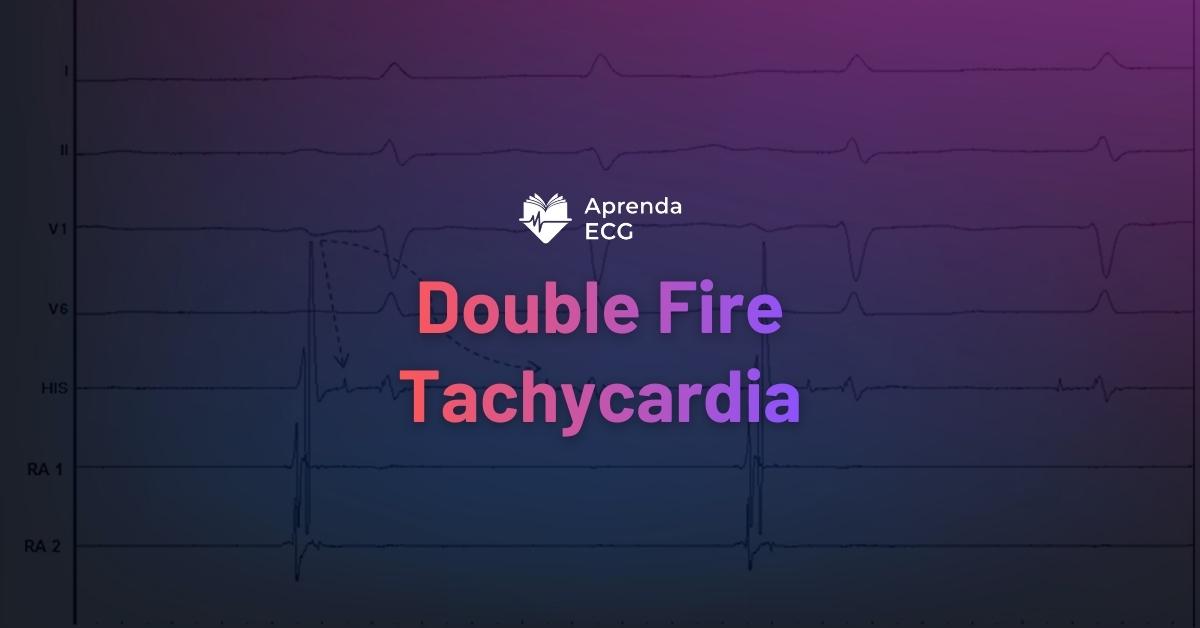
Double fire tachycardia (dual AV nodal nonreentrant tachycardia) is one of the most sophisticated manifestations of atrioventricular nodal physiology. Rare, frequently underdiagnosed, and often mistaken for atrial fibrillation, it represents a purely anterograde phenomenon of dual conduction through the AV node, without reentry.
Also known as nonreentrant nodal tachycardia with 1:2 conduction, so-called double fire is essentially the extreme result of dual AV nodal pathway physiology.

The Substrate: Dual AV Nodal Pathway Physiology
The presence of two functional pathways in the AV node, a fast pathway and a slow pathway, is a relatively common phenomenon.
Under usual conditions:
- The fast pathway conducts with a shorter conduction time and a longer refractory period.
- The slow pathway conducts with a longer delay, but with a shorter refractory period.
This longitudinal dissociation is the classic substrate for AV nodal reentrant tachycardia (AVNRT). In double fire tachycardia, however, there is no closed circuit. There is no retrograde return sustaining the phenomenon.
Here, a single P wave is able to conduct simultaneously down both pathways, reaching the His-Purkinje system at two different moments.
The Double Fire Mechanism
For double fire tachycardia to occur, several electrophysiological conditions must coexist:
- Significant conduction delay over the slow pathway.
- A substantial difference between the conduction times of the fast and slow pathways.
- A His-Purkinje refractory period shorter than the difference between the two conduction times.
- Absent or minimal effective ventriculoatrial conduction.
The key point is this:
The impulse traveling down the fast pathway cannot penetrate retrogradely and block the slow pathway. Conduction over the slow pathway therefore continues and generates a second QRS.
We thus have a 1:2 pattern: one P wave, two QRS complexes.
No circuit.
No reentry.
Just dual anterograde conduction.
Schematic Representation
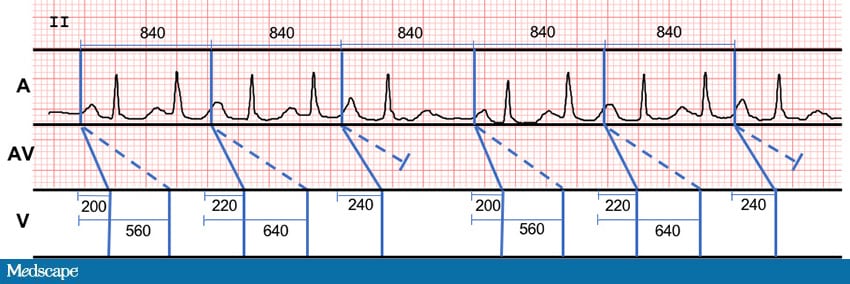
The diagram shows:
- Immediate conduction over the fast pathway.
- Delayed conduction over the slow pathway.
- Two ventricular activations arising from the same atrial beat.
The mean difference between fast and slow activation times described in published cases is around 300-400 ms.
Clinical Consequences
Although rare, double fire tachycardia can be incessant.
Reported cases show:
- Frequent misdiagnosis as atrial fibrillation.
- Ineffective use of multiple classes of antiarrhythmic drugs.
- Development of reversible tachycardia-induced cardiomyopathy.
Slow pathway ablation is consistently curative, eliminating the phenomenon by removing the substrate for delayed conduction.
Conclusion
Double fire tachycardia is an elegant reminder that the AV node is not a homogeneous structure.
When the time difference between the fast and slow pathways exceeds the distal refractory threshold, nodal physiology stops being silent and starts producing two ventricular activations for each atrial beat.
It is rare.
It is counterintuitive.
But it is pure applied electrophysiology, and it can easily be mistaken for atrial fibrillation if not correctly recognized.
References
- Wang NC. Dual atrioventricular nodal nonreentrant tachycardia: A systematic review . Pacing Clin Electrophysiol. 2011;34(12):1671–1681. DOI: 10.1111/j.1540-8159.2011.03218.x
- Gopinathannair R, Olshansky B. Double Fire Tachycardia: Dual AV Nodal Nonreentrant Tachycardia . Medscape. 2017.