

After analyzing the cardiac rhythm, the next step in ECG interpretation is determining the heart rate (HR). There are different methods to calculate HR, depending on whether the rhythm is regular or irregular. Let’s go through each of them.
Methods for Regular Rhythms
In regular rhythms, HR can be calculated accurately using the standard ECG paper speed of 25 mm/s. This means that 1 second equals 25 mm on the tracing and that 1 minute (60 seconds) equals 1500 mm.
1. Small Box Method
- Count the number of small boxes between two consecutive QRS complexes.
- Divide 1500 by the number of small boxes.
- Example: if the RR interval spans 25 small boxes, the HR is 60 bpm (1500/25 = 60).
2. Large Box Method
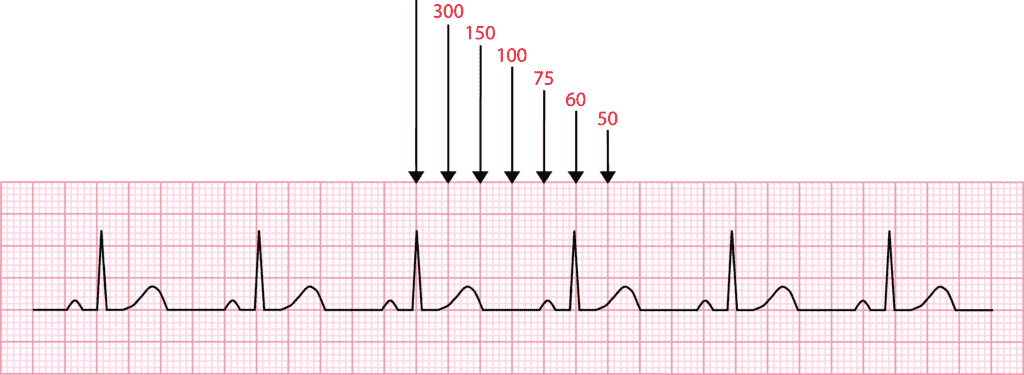
- For a quick estimate, count the number of large boxes between two QRS complexes and divide 300 by that number.
- Example:
- 1 large box → 300 bpm
- 2 large boxes → 150 bpm
- 3 large boxes → 100 bpm
- 4 large boxes → 75 bpm
- 5 large boxes → 60 bpm
- 6 large boxes → 50 bpm
- Example:
3. Calculation From the RR Interval in Seconds
- The RR interval can be converted into seconds (each small box = 0.04 s).
- HR is obtained with the formula: 60 divided by the RR interval (in seconds).
- Example: if an RR interval is 0.75 s, the HR is 80 bpm (60/0.75 = 80).
Methods for Irregular Rhythms
When the rhythm is irregular, as in atrial fibrillation, the traditional box method is not as reliable. In these cases, an estimate based on a fixed time interval is used.
1. Counting QRS Complexes in 6 Seconds
- Count the number of QRS complexes in 6 seconds (30 large boxes) and multiply by 10.
- Example: if there are 10 QRS complexes in 6 seconds, the HR is 100 bpm (10 x 10 = 100).
A practical tip: most capped BIC pens are 150 mm long, equivalent to 30 large boxes, making it easy to mark out the 6-second interval.
Normal Heart Rate Values
According to the Brazilian ECG Interpretation Guideline, normal HR in adults ranges from 50 to 100 bpm. Values below or above this range may indicate bradycardia or tachycardia, respectively.
Conclusion
Calculating the HR is an essential step in ECG analysis and can be done in different ways, depending on the rhythm. With practice, you will be able to determine the HR quickly and identify clinically relevant changes.


