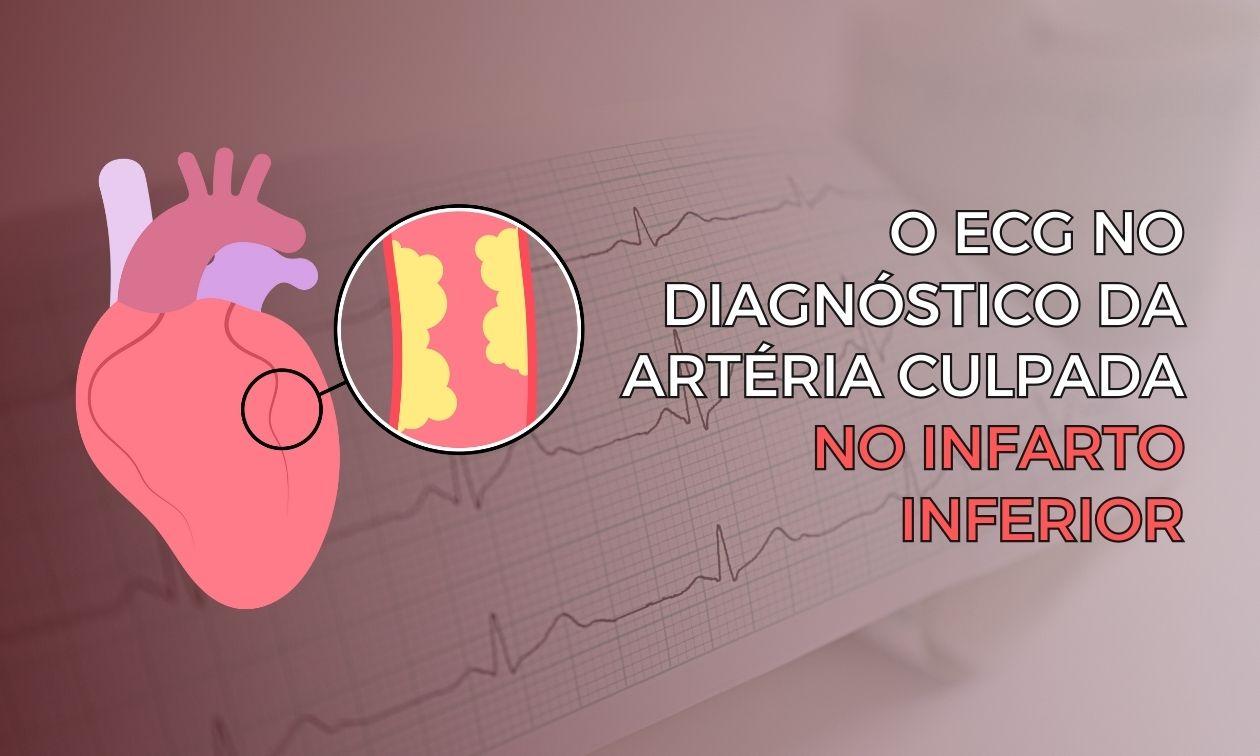
Inferior wall ST-elevation myocardial infarction (STEMI) is estimated to account for 40% to 50% of all STEMIs, with mortality ranging from 2% to 9%. It is mainly caused by acute thrombotic occlusion of the right coronary artery (RCA) or the left circumflex artery (LCx). Identifying the culprit artery is clinically important, because the course may differ in each case. While bradyarrhythmias are more common in RCA occlusions, LCx occlusions can lead to papillary muscle dysfunction and acute mitral regurgitation.
Importance of the Electrocardiogram in the Emergency Department
The electrocardiogram is an indispensable diagnostic tool in emergency department patients with suspected acute coronary occlusion (ACO), and it can help differentiate RCA from LCx occlusion. Several studies, especially over the last 3 decades, have analyzed electrocardiographic criteria that contribute to this differentiation.
Table of Electrocardiographic Criteria
The various electrocardiographic criteria are summarized in the table below:
| Criteria | RCA culprit | LCx culprit |
|---|---|---|
| ST depression in I | Present | Absent |
| ST depression in aVL | Present | Absent |
| ST depression in I and aVL | aVL > I | Absent |
| ST elevation in II and III | III > II | II > III |
| ST elevation in V5 and/or V6 | Absent | Present |
| ST depression in aVR | Absent | Present |
| ST depression in V1 | Absent | Present |
| Ratio of ST depression in V3/ST elevation in III | ≤1.2 | >1.2 |
| Ratio of Σ ST depression V1 to V3/Σ ST elevation II, III, and aVF | <1 | ≥1 |
| ST elevation in V1 | Present | Absent |
| ST depression aVR/ST depression aVL | <1 | ≥1 |
Recent Findings from Systematic Reviews
However, some points deserve emphasis. The results of two recently published systematic reviews with meta-analysis showed that the best criteria for identifying the culprit artery in inferior MI were ST-segment elevation in III > II and ST-segment depression in aVL > I.
When both criteria are present on the electrocardiogram, meta-analysis data showed a sensitivity of 80%, specificity of 92%, positive likelihood ratio of 10, and negative likelihood ratio of 0.21 for RCA occlusion.
Limitations of the Algorithms
Surprisingly, none of the algorithms tested in the meta-analysis (such as those by Fiol and Tierala) proved superior to the criteria above. The authors note that this is because the excellent accuracy shown in the original studies was not reproduced in external cohorts.
In addition, there is an algorithm designed to localize proximal and distal RCA and LCx occlusions; however, it should be applied with caution, since it lacks external validation and its likelihood ratios are not good. Finally, several authors warn about cases with severe lesions in both the RCA and the LCx; in these patients, the diagnostic performance of all these criteria is quite limited.
Conclusion
In conclusion, the electrocardiogram, when carefully interpreted, can significantly help in the differential diagnosis of the culprit artery in inferior MI. Standardizing the use of simpler, well-validated electrocardiographic criteria can optimize the care of patients with this condition.
Key Points
- Inferior STEMI accounts for 40%-50% of cases and has a mortality of 2%-9%.
- It is usually caused by RCA or LCx occlusion.
- ST elevation in III > II and ST depression in aVL > I show high specificity and sensitivity for RCA occlusion.
- Algorithms such as those by Fiol and Tierala were not superior to these criteria, and diagnostic performance is limited in combined RCA and LCx lesions.
References
- Zhou P, Wu Y, Wang M et al. Identifying the culprit artery via 12-lead electrocardiogram in inferior wall ST-segment elevation myocardial infarction: A meta-analysis. Ann Noninvasive Electrocardiol. 2023;28:e13016.
- Liang H, Wu L, Li Y, et al. Electrocardiogram Criteria of Limb Leads Predicting Right Coronary Artery as Culprit Artery in Inferior Wall Myocardial Infarction: A Meta-Analysis. Medicine. 2018;97(24):e10889.
- Ravi H, James W, Birnbaum Y. Introducing a new algorithm in inferior ST-segment elevation myocardial infarction to predict the culprit artery and distinguish proximal versus distal lesions. Coronary Artery Disease 2011;22:165–170.
- Tierala I, Nikus KC, Sclarovsky S et al. Predicting the culprit artery in acute ST-elevation myocardial infarction and introducing a new algorithm to predict infarct-related artery in inferior ST-elevation myocardial infarction: Correlation with coronary anatomy in the HAAMU trial. J Electrocardiol 2009;42(2):120–127.