

🩺 When should you order the lateral chest leads?
Leads V7, V8, and V9 should be recorded whenever there is suspicion of acute infarction of the lateral wall of the left ventricle. This may happen:
- When the 12-lead ECG shows ST depression in V1–V3, especially horizontal;
- In cases of typical chest pain with an apparently normal initial ECG;
Lateral wall infarction can go unnoticed on the standard ECG, because this region of the myocardium is not directly “seen” by the standard leads. Leads V7, V8, and V9 are essential for detecting these cases, and they can change management!
📍 How to place V7, V8, and V9
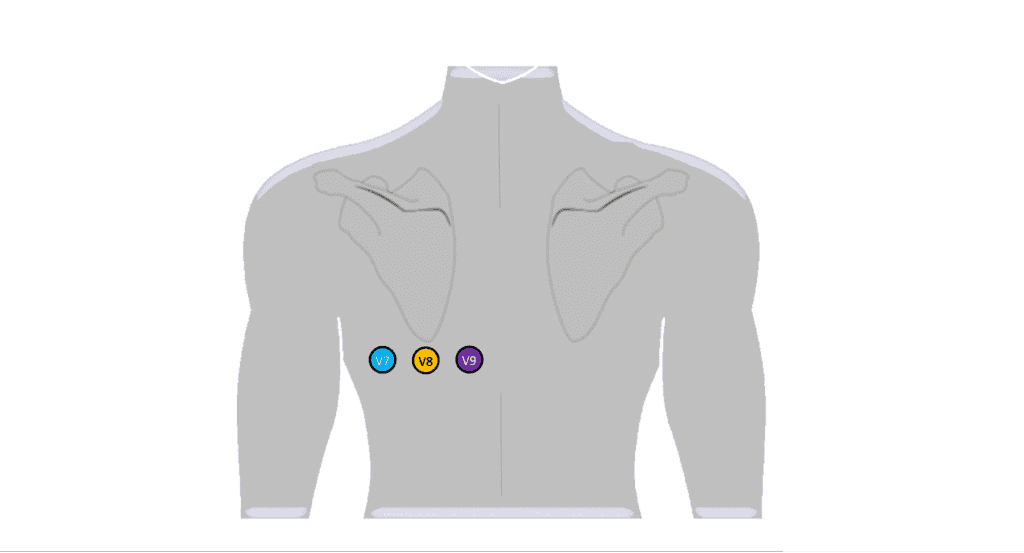
Leads V7, V8, and V9 are recorded on the patient's back, at the same horizontal level as V6 (5th intercostal space). Here is the position of each one:
- V7: left posterior axillary line
- V8: left midscapular line
- V9: left paravertebral line
🔎 Practical tip: you can reuse the V4, V5, and V6 cables to record these leads, noting on the ECG that they are V7–V9.
⚡ What should you look for in these leads?
The main electrocardiographic finding in posterior infarction is ST-segment elevation in V7, V8, and V9.
✔ Diagnostic criterion:
- ST elevation ≥ 0.5 mm in at least two of these leads, with a compatible clinical picture, suggests acute coronary occlusion of the circumflex artery and lateral wall infarction.
Other findings that may appear:
- Development of Q waves in V7–V9 (indicating necrosis);
- Reciprocal ST depression in V1–V3, with tall R waves, which are the “mirror image” of the lateral ST elevation (V7-V9).