

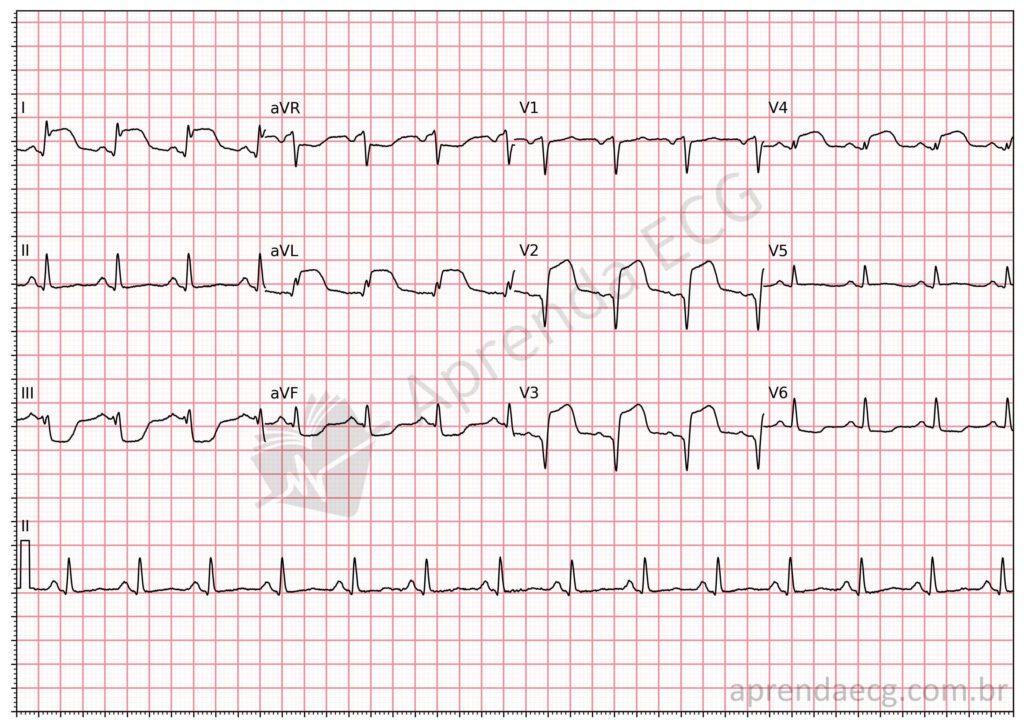
Tombstone ST-segment elevation (tombstoning ST segment elevation) is a striking electrocardiographic pattern of acute myocardial infarction (AMI), associated with greater severity and a worse prognosis. The name comes from the characteristic morphology of the ST segment, which takes on a pronounced convex shape resembling a tombstone. This pattern reflects extensive ischemia and correlates with higher mortality and left ventricular dysfunction, especially in anterior wall infarctions caused by proximal occlusion of the left anterior descending artery.
ECG Criteria
The ECG criteria for the tombstone pattern were first described by Wimalaratna and later modified by Guo. The main criteria include:
- Absence of a recognizable R wave or presence of an R wave with duration ≤ 40 ms and minimal amplitude.
- Convex, upsloping ST-segment elevation that merges with the descending limb of the R wave or with the QS/QR complex.
- ST-segment peak higher than the R wave.
- Fusion of the ST segment with the T wave.
This pattern is found in approximately 10% to 26.1% of patients with STEMI and is more frequent in anterior wall infarctions, due to occlusion of the left anterior descending artery.
Pathophysiology and Prognostic Implications
The tombstone pattern is related to delayed transmural conduction and intramyocardial block, resulting in a larger infarct and left ventricular dysfunction. The main pathophysiological mechanisms include:
- Rapid progression of myocardial necrosis, reducing the effectiveness of reperfusion therapies.
- Insufficient collateral circulation, limiting protection of the ischemic myocardium.
- Diffuse coronary artery disease, indicating an advanced atherosclerotic substrate.
- Inadequate ischemic preconditioning effect, which in other settings can attenuate infarct extent.
Proximal occlusion of a major coronary artery, without sufficient collateral protection, rapidly leads to complete transmural injury, which is reflected in the ECG features of the tombstone pattern.
Conclusion
The tombstone ST-segment elevation pattern is an electrocardiographic marker of extensive, high-risk infarctions. Its early recognition is essential for prognostic stratification, as it is associated with higher mortality and serious complications such as heart failure and malignant arrhythmias.
References
- Wimalaratna HSK. “Tombstoning” of ST segment in acute myocardial infarction. Lancet. 1993;342(8869):496.
- Guo XH, Yap YG, Chen LJ, Huang J, et al. Correlation of coronary angiography with “tombstoning” electrocardiographic pattern in patients after acute myocardial infarction. Clin Cardiol. 2000;23(5):347–52.
- Balci B. Tombstoning ST-Elevation Myocardial Infarction. Curr Cardiol Rev. 2009;5(4):273–8.
- Balci B, Yesildag O. Correlation between clinical findings and the “tombstoning” electrocardiographic pattern in patients with anterior wall acute myocardial infarction. Am J Cardiol. 2003;92(11):1316–8.