Introduction
The diagnosis of Acute Myocardial Infarction (MI) is going through a period of transition. For a long time, the STEMI-NSTEMI model (ST-elevation infarction vs. non-ST-elevation infarction) guided the treatment of acute coronary events. Although it contributed to important improvements, it shows limitations in scenarios where the ECG does not display “classic” ST elevation, yet there is a coronary occlusion.
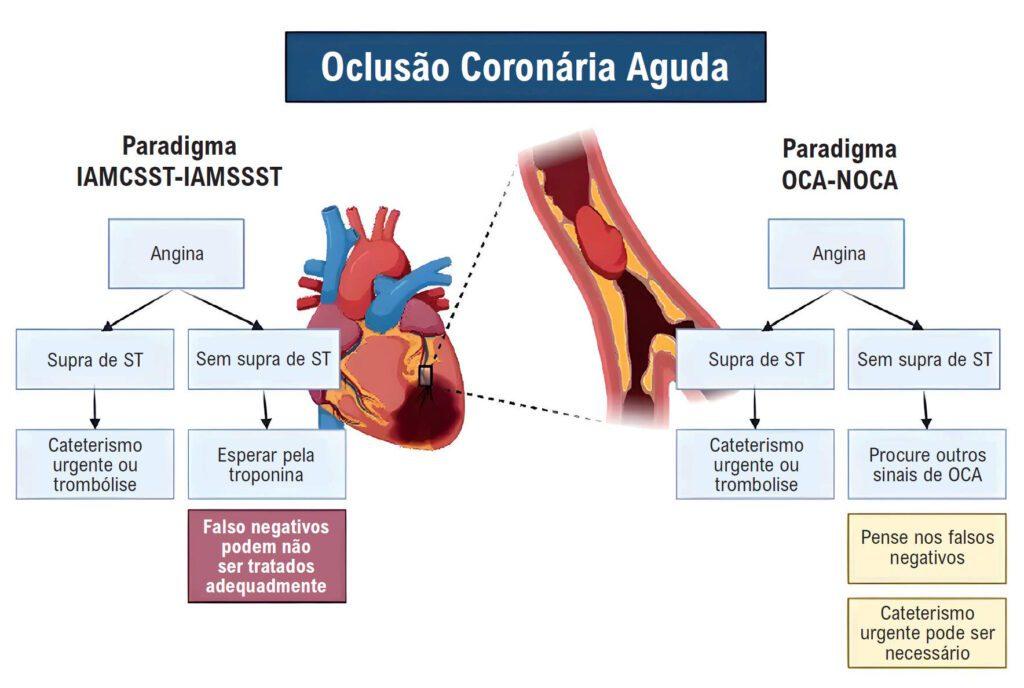
In this text, we suggest a review of this paradigm. Instead of separating patients into STEMI or NSTEMI, we propose the terms OMI (Acute Coronary Occlusion) and NOMI (No Acute Coronary Occlusion). This new classification emphasizes the anatomical and physiological reality of the event, going beyond simple electrocardiographic changes. Our goal is to foster debate in cardiology about more effective strategies for treating MI.
A Brief History of the STEMI-NSTEMI Model
Since the turn of the century, MI has traditionally been categorized solely on the basis of electrocardiographic (ECG) findings. The presence of ST-segment elevation determined the division between STEMI and NSTEMI. This new model replaced the old terms “Q-wave MI” and “non-Q-wave MI” and helped drive reperfusion therapy, especially thrombolysis.
However, evidence soon emerged that a substantial proportion of patients with truly occluded arteries do not meet STEMI criteria. In other words, even without ST elevation, they may have a completely occluded coronary artery and would need urgent reperfusion.
The Limitations of the STEMI vs. NSTEMI Paradigm
Our team showed in an important meta-analysis that the sensitivity of ST elevation for identifying occlusions is only 43.6%. That is, out of every 100 patients with an occluded artery, only 43.6 will have “classic” ST elevation on the ECG. This is a low rate for a sign that used to be considered the main “gateway” to immediate reperfusion. When this ST elevation is absent, the likelihood of undertreatment is high.
In addition, several clinical registries indicate that a substantial percentage of patients labeled as NSTEMI have TIMI 0 coronary flow (with the artery completely occluded), high mortality, and extensive infarctions. The problem is that, when the need for emergent reperfusion is defined exclusively by ST elevation, these patients are left out of the immediate strategy of opening the coronary artery.
The Urgency of Treating Occluded Coronary Arteries: Time Is Muscle
In OMI, delaying reperfusion can lead to irreversible loss of heart muscle. While troponin is an important biomarker of myocardial injury, it takes time to rise and does not distinguish, in the acute phase, a completely occluded artery from other situations.
Some trials that show no clear benefit of early intervention in NSTEMI are frequently cited. However, most of these studies defined “early” as somewhere between 4.7 and 16 hours, far beyond the standard established for STEMI (up to 90 minutes). In addition, a significant percentage of the patients enrolled in certain trials did not have positive troponin (unstable angina), which dilutes the results. In contrast, studies that evaluated a truly emergent approach, at around 1 to 2 hours, suggest a reduction in mortality and reinfarction.
Therefore, immediate reperfusion is not proposed for every NSTEMI, but rather an active search for OMI cases within this group, especially in patients with persistent chest pain and less obvious electrocardiographic signs.
The New Paradigm: OMI/NOMI
To overcome the limits of the traditional model, the OMI/NOMI approach was proposed, focusing on anatomical and physiological data:
- OMI (Acute Coronary Occlusion): situations in which there is an occluded or near-occluded artery, with a risk of extensive transmural infarction. These patients require immediate reperfusion, whether or not the ECG shows ST elevation.
- NOMI (No Acute Coronary Occlusion): patients without total occlusion. Although there is still a risk of future thrombosis or ischemia, emergent reperfusion is generally not needed. Troponin and other methods can be used with less urgency, allowing a more considered decision.
This model helps prioritize the structural aspect of the disease, preventing patients with an occluded artery from going without emergent treatment because they do not show “classic” signs on the ECG.
Our Proposed Approach for Patients with Chest Pain in the Emergency Department
To improve the identification of OMI, we suggest the following steps:
- Immediate ECG (within 10 minutes): every patient with risk factors and a presentation suggestive of ischemic chest pain should have an electrocardiogram performed promptly.
- Look for ST elevation: although an important sign, it is insufficient to rule out OMI. It therefore requires careful assessment.
- Look for other signs of OMI:
- Subtle ST elevation, hyperacute T waves, or QRS distortion.
- ST depression in specific leads, suggesting transmural ischemia.
- Atypical electrocardiographic patterns that may indicate occlusion (for example, the “de Winter pattern” or special criteria in the presence of bundle branch blocks).
- Serial ECGs and comparison with previous tracings: dynamic changes strengthen the hypothesis of ischemia even when the first ECG is normal or inconclusive.
- Anti-anginal treatment and symptom assessment: in case of ongoing pain, immediate referral for catheterization should be considered, even without “classic” STEMI criteria.
Conclusion
The paradigm based solely on ST elevation (STEMI vs. NSTEMI) does not cover all cases of MI in which the artery is truly occluded. The OMI/NOMI proposal allows a more anatomical and physiological view, shifting the focus to the artery that needs to be opened quickly. The limited sensitivity of “ST elevation” (43.6%, according to de Alencar et al. 2024) highlights the need for a broader perspective, capable of detecting subtle signs of occlusion.
By incorporating advanced ECG analysis techniques, imaging, and continuous monitoring of at-risk patients, cardiology can offer more accurate and timely treatment, preserving heart muscle and improving clinical outcomes. Ultimately, this new way of approaching MI may redefine practice, ensuring dedicated attention to those who truly need urgent reperfusion.
References
- McLaren J, de Alencar JN, Aslanger EK, Meyers HP, Smith SW. From ST-Segment Elevation MI to Occlusion MI: The New Paradigm Shift in Acute Myocardial Infarction. JACC Adv. 2024;3(11):101314.
- Alencar JN De, Feres F, Marchi MFN De, Franchini KG, Scheffer MK, Felicioni SP, et al. Além do Paradigma IAMCSST-IAMSSST: Proposta do Instituto Dante Pazzanese para o Diagnóstico de Oclusão Coronariana Aguda. Arq Bras Cardiol. 2024;121(5):e20230733.
- de Alencar Neto JN, Scheffer MK, Correia BP, Franchini KG, et al. Systematic review and meta-analysis of diagnostic test accuracy of ST-segment elevation for acute coronary occlusion. Int J Cardiol. 2024;131889.
- McLaren J, de Alencar JN, Aslanger EK, Meyers HP, Smith SW. From ST-Segment Elevation MI to Occlusion MI: The New Paradigm Shift in Acute Myocardial Infarction. JACC Adv. 2024;3(11):101314.
- Aslanger EK, Yıldırımtürk Ö, Şimşek B, Bozbeyoğlu E, et al. DIagnostic accuracy oF electrocardiogram for acute coronary OCClUsion resuLTing in myocardial infarction (DIFOCCULT Study). IJC Hear Vasc. 2020;30.